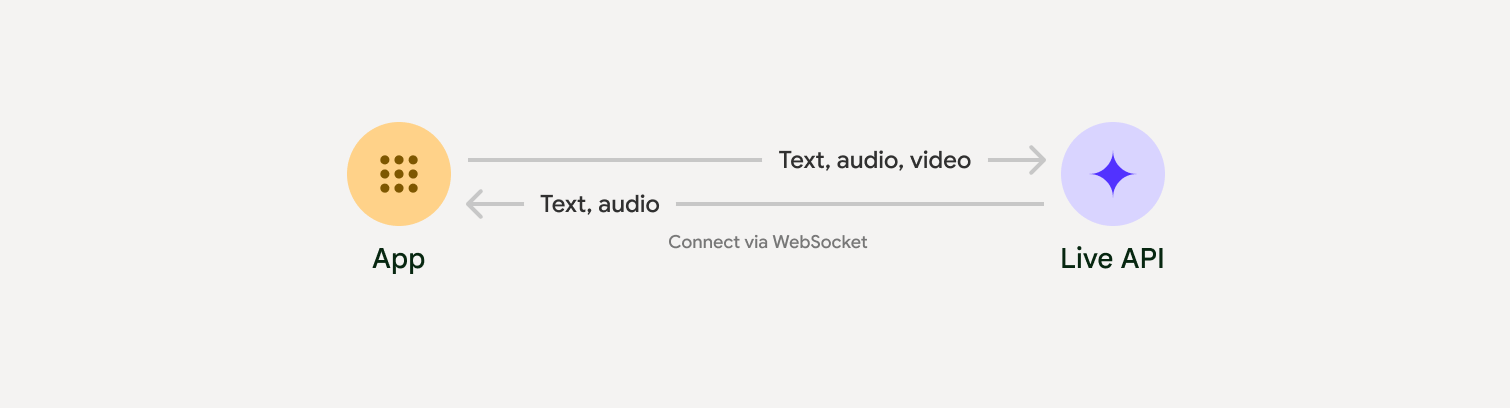
Get started with Live API

Live API를 사용하면 Gemini와 지연 시간이 짧은 실시간 음성 및 동영상 상호작용을 할 수 있습니다. 오디오, 동영상 또는 텍스트의 연속 스트림을 처리하여 즉각적이고 사람과 유사한 음성 응답을 제공하므로 사용자에게 자연스러운 대화형 환경을 제공합니다.

Live API 개요

Live API는 음성 활동 감지, 도구 사용 및 함수 호출, 세션 관리 (장기 대화 관리용), 일시적 토큰 (안전한 클라이언트 측 인증용)과 같은 포괄적인 기능을 제공합니다.

이 페이지에서는 예시와 기본 코드 샘플을 통해 시작할 수 있습니다.

Google AI Studio에서 Live API 사용해 보기

구현 접근 방식 선택

Live API와 통합할 때는 다음 구현 접근 방식 중 하나를 선택해야 합니다.

  • 서버 간: 백엔드가 WebSockets를 사용하여 Live API에 연결됩니다. 일반적으로 클라이언트는 스트림 데이터 (오디오, 동영상, 텍스트)를 서버로 전송하고 서버는 이를 Live API로 전달합니다.
  • 클라이언트-서버: 프런트엔드 코드가 WebSockets를 사용하여 Live API에 직접 연결하여 백엔드를 우회하여 데이터를 스트리밍합니다.

파트너 연동

실시간 오디오 및 동영상 앱의 개발을 간소화하려면 WebRTC 또는 WebSockets를 통해 Gemini Live API를 지원하는 서드 파티 통합을 사용하면 됩니다.

시작하기

이 서버 측 예시에서는 마이크에서 오디오를 스트리밍하고 반환된 오디오를 재생합니다. 클라이언트 애플리케이션을 포함한 전체 엔드 투 엔드 예시는 예시 애플리케이션을 참고하세요.

입력 오디오 형식은 16비트 PCM, 16kHz, 모노 형식이어야 하며 수신된 오디오는 24kHz의 샘플링 레이트를 사용합니다.

Python

오디오 스트리밍용 도우미를 설치합니다. 추가 시스템 수준 종속 항목(예: portaudio)이 필요할 수 있습니다. 자세한 설치 단계는 PyAudio 문서를 참고하세요.

pip install pyaudio
import asyncio
from google import genai
import pyaudio

client = genai.Client()

# --- pyaudio config ---
FORMAT = pyaudio.paInt16
CHANNELS = 1
SEND_SAMPLE_RATE = 16000
RECEIVE_SAMPLE_RATE = 24000
CHUNK_SIZE = 1024

pya = pyaudio.PyAudio()

# --- Live API config ---
MODEL = "gemini-2.5-flash-native-audio-preview-09-2025"
CONFIG = {
    "response_modalities": ["AUDIO"],
    "system_instruction": "You are a helpful and friendly AI assistant.",
}

audio_queue_output = asyncio.Queue()
audio_queue_mic = asyncio.Queue(maxsize=5)
audio_stream = None

async def listen_audio():
    """Listens for audio and puts it into the mic audio queue."""
    global audio_stream
    mic_info = pya.get_default_input_device_info()
    audio_stream = await asyncio.to_thread(
        pya.open,
        format=FORMAT,
        channels=CHANNELS,
        rate=SEND_SAMPLE_RATE,
        input=True,
        input_device_index=mic_info["index"],
        frames_per_buffer=CHUNK_SIZE,
    )
    kwargs = {"exception_on_overflow": False} if __debug__ else {}
    while True:
        data = await asyncio.to_thread(audio_stream.read, CHUNK_SIZE, **kwargs)
        await audio_queue_mic.put({"data": data, "mime_type": "audio/pcm"})

async def send_realtime(session):
    """Sends audio from the mic audio queue to the GenAI session."""
    while True:
        msg = await audio_queue_mic.get()
        await session.send_realtime_input(audio=msg)

async def receive_audio(session):
    """Receives responses from GenAI and puts audio data into the speaker audio queue."""
    while True:
        turn = session.receive()
        async for response in turn:
            if (response.server_content and response.server_content.model_turn):
                for part in response.server_content.model_turn.parts:
                    if part.inline_data and isinstance(part.inline_data.data, bytes):
                        audio_queue_output.put_nowait(part.inline_data.data)

        # Empty the queue on interruption to stop playback
        while not audio_queue_output.empty():
            audio_queue_output.get_nowait()

async def play_audio():
    """Plays audio from the speaker audio queue."""
    stream = await asyncio.to_thread(
        pya.open,
        format=FORMAT,
        channels=CHANNELS,
        rate=RECEIVE_SAMPLE_RATE,
        output=True,
    )
    while True:
        bytestream = await audio_queue_output.get()
        await asyncio.to_thread(stream.write, bytestream)

async def run():
    """Main function to run the audio loop."""
    try:
        async with client.aio.live.connect(
            model=MODEL, config=CONFIG
        ) as live_session:
            print("Connected to Gemini. Start speaking!")
            async with asyncio.TaskGroup() as tg:
                tg.create_task(send_realtime(live_session))
                tg.create_task(listen_audio())
                tg.create_task(receive_audio(live_session))
                tg.create_task(play_audio())
    except asyncio.CancelledError:
        pass
    finally:
        if audio_stream:
            audio_stream.close()
        pya.terminate()
        print("\nConnection closed.")

if __name__ == "__main__":
    try:
        asyncio.run(run())
    except KeyboardInterrupt:
        print("Interrupted by user.")

자바스크립트

오디오 스트리밍용 도우미를 설치합니다. 추가 시스템 수준 종속 항목이 필요할 수 있습니다 (Mac/Windows의 경우 sox, Linux의 경우 ALSA). 자세한 설치 단계는 스피커마이크 문서를 참고하세요.

npm install mic speaker
import { GoogleGenAI, Modality } from '@google/genai';
import mic from 'mic';
import Speaker from 'speaker';

const ai = new GoogleGenAI({});
// WARNING: Do not use API keys in client-side (browser based) applications
// Consider using Ephemeral Tokens instead
// More information at: https://ai.google.dev/gemini-api/docs/ephemeral-tokens

// --- Live API config ---
const model = 'gemini-2.5-flash-native-audio-preview-09-2025';
const config = {
  responseModalities: [Modality.AUDIO],
  systemInstruction: "You are a helpful and friendly AI assistant.",
};

async function live() {
  const responseQueue = [];
  const audioQueue = [];
  let speaker;

  async function waitMessage() {
    while (responseQueue.length === 0) {
      await new Promise((resolve) => setImmediate(resolve));
    }
    return responseQueue.shift();
  }

  function createSpeaker() {
    if (speaker) {
      process.stdin.unpipe(speaker);
      speaker.end();
    }
    speaker = new Speaker({
      channels: 1,
      bitDepth: 16,
      sampleRate: 24000,
    });
    speaker.on('error', (err) => console.error('Speaker error:', err));
    process.stdin.pipe(speaker);
  }

  async function messageLoop() {
    // Puts incoming messages in the audio queue.
    while (true) {
      const message = await waitMessage();
      if (message.serverContent && message.serverContent.interrupted) {
        // Empty the queue on interruption to stop playback
        audioQueue.length = 0;
        continue;
      }
      if (message.serverContent && message.serverContent.modelTurn && message.serverContent.modelTurn.parts) {
        for (const part of message.serverContent.modelTurn.parts) {
          if (part.inlineData && part.inlineData.data) {
            audioQueue.push(Buffer.from(part.inlineData.data, 'base64'));
          }
        }
      }
    }
  }

  async function playbackLoop() {
    // Plays audio from the audio queue.
    while (true) {
      if (audioQueue.length === 0) {
        if (speaker) {
          // Destroy speaker if no more audio to avoid warnings from speaker library
          process.stdin.unpipe(speaker);
          speaker.end();
          speaker = null;
        }
        await new Promise((resolve) => setImmediate(resolve));
      } else {
        if (!speaker) createSpeaker();
        const chunk = audioQueue.shift();
        await new Promise((resolve) => {
          speaker.write(chunk, () => resolve());
        });
      }
    }
  }

  // Start loops
  messageLoop();
  playbackLoop();

  // Connect to Gemini Live API
  const session = await ai.live.connect({
    model: model,
    config: config,
    callbacks: {
      onopen: () => console.log('Connected to Gemini Live API'),
      onmessage: (message) => responseQueue.push(message),
      onerror: (e) => console.error('Error:', e.message),
      onclose: (e) => console.log('Closed:', e.reason),
    },
  });

  // Setup Microphone for input
  const micInstance = mic({
    rate: '16000',
    bitwidth: '16',
    channels: '1',
  });
  const micInputStream = micInstance.getAudioStream();

  micInputStream.on('data', (data) => {
    // API expects base64 encoded PCM data
    session.sendRealtimeInput({
      audio: {
        data: data.toString('base64'),
        mimeType: "audio/pcm;rate=16000"
      }
    });
  });

  micInputStream.on('error', (err) => {
    console.error('Microphone error:', err);
  });

  micInstance.start();
  console.log('Microphone started. Speak now...');
}

live().catch(console.error);

예시 애플리케이션

포괄적인 사용 사례에 Live API를 사용하는 방법을 보여주는 다음 예시 애플리케이션을 확인하세요.

  • JavaScript 라이브러리를 사용하여 Live API에 연결하고 마이크와 스피커를 통해 양방향 오디오를 스트리밍하는 AI Studio의 라이브 오디오 스타터 앱
  • 추가 예시와 시작 가이드는 파트너 통합을 참고하세요.

다음 단계

  • 음성 활동 감지 및 네이티브 오디오 기능을 비롯한 주요 기능 및 구성에 관한 전체 Live API 기능 가이드를 읽어보세요.
  • 도구 사용 가이드를 읽고 Live API를 도구 및 함수 호출과 통합하는 방법을 알아보세요.
  • 장기 실행 대화를 관리하려면 세션 관리 가이드를 참고하세요.
  • 클라이언트-서버 애플리케이션에서 보안 인증을 위해 임시 토큰 가이드를 읽어보세요.
  • 기본 WebSockets API에 관한 자세한 내용은 WebSockets API 참조를 참고하세요.