

העיגון באמצעות חיפוש Google מחבר את מודל Gemini לתוכן מהאינטרנט שמתעדכן בזמן אמת, ועובד בכל השפות הזמינות. כך Gemini יכול לתת תשובות מדויקות יותר ולצטט מקורות ניתנים לאימות, מעבר לתאריך סף הידע שלו.
ההארקה עוזרת לכם ליצור אפליקציות שיכולות:
- שיפור הדיוק העובדתי: כדי לצמצם את ההזיות של המודל, התשובות מבוססות על מידע מהעולם האמיתי.
- גישה למידע בזמן אמת: קבלת תשובות לשאלות על אירועים ונושאים עדכניים.
ציטוט מקורות: כדי לבנות את אמון המשתמשים, כדאי להציג את המקורות של הטענות שהמודל מציג.
Python
from google import genai

client = genai.Client()

interaction = client.interactions.create(
    model="gemini-3.8-flash",
    input="Who won the euro 2024?",
    tools=[{"type": "google_search"}]
)

print(interaction.output_text)
JavaScript
import { GoogleGenAI } from "@google/genai";

const client = new GoogleGenAI({});

const interaction = await client.interactions.create({
    model: "gemini-3.8-flash",
    input: "Who won the euro 2024?",
    tools: [{ type: "google_search" }]
});

console.log(interaction.output_text);
Java
import com.google.genai.Client;
import com.google.genai.gaos.models.interactions.CreateModelInteraction;
import com.google.genai.gaos.models.interactions.GoogleSearch;
import com.google.genai.gaos.models.interactions.Interaction;
import com.google.genai.gaos.models.interactions.InteractionsInput;
import com.google.genai.gaos.models.interactions.Model;
import com.google.genai.gaos.models.operations.CreateInteractionRequestBody;
import java.util.Arrays;

Client client = new Client();

CreateModelInteraction params =
    CreateModelInteraction.builder()
        .model(Model.of("gemini-3.8-flash"))
        .input(InteractionsInput.of("Who won the euro 2024?"))
        .tools(Arrays.asList(GoogleSearch.builder().build()))
        .build();

Interaction interaction =
    client.interactions.create(CreateInteractionRequestBody.of(params)).interaction().get();

System.out.println(interaction.outputText().orElse(""));
Go
package main

import (
    "context"
    "fmt"
    "log"

    "google.golang.org/genai"
    "google.golang.org/genai/interactions/models/interactions"
    "google.golang.org/genai/interactions/models/operations"
)

func main() {
    ctx := context.Background()
    client, err := genai.NewClient(ctx, nil)
    if err != nil {
        log.Fatal(err)
    }

    resp, err := client.Interactions.Create(ctx, operations.CreateInteractionRequest{
        Body: operations.NewCreateInteractionRequestBody(
            interactions.CreateModelInteraction{
                Model: interactions.Model("gemini-3.8-flash"),
                Input: interactions.NewInteractionsInput("Who won the euro 2024?"),
                Tools: []interactions.Tool{
                    interactions.NewTool(interactions.GoogleSearch{}),
                },
            },
        ),
    })
    if err != nil {
        log.Fatal(err)
    }

    fmt.Println(resp.Interaction.GetOutputText())
}
REST
curl -X POST "https://generativelanguage.googleapis.com/v1beta/interactions" \
  -H "x-goog-api-key: $GEMINI_API_KEY" \
  -H "Content-Type: application/json" \
  -d '{
    "model": "gemini-3.8-flash",
    "input": "Who won the euro 2024?",
    "tools": [{"type": "google_search"}]
  }'
איך עיגון באמצעות חיפוש Google פועל
כשמפעילים את הכלי google_search, המודל מטפל בכל תהליך העבודה של חיפוש, עיבוד וציטוט מידע באופן אוטומטי.
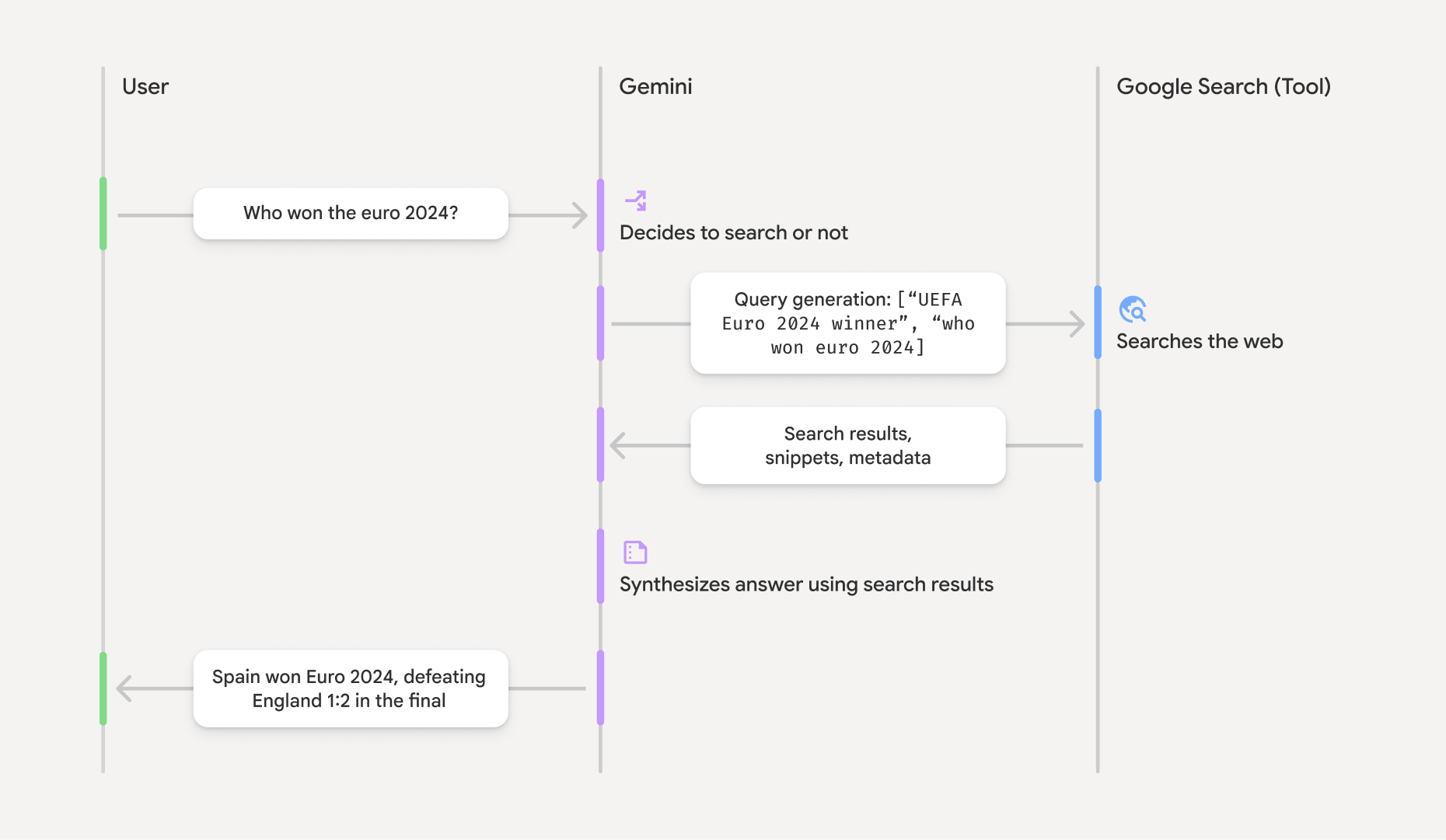
- הנחיית משתמש: האפליקציה שולחת הנחיית משתמש ל-Gemini API עם הכלי
google_searchמופעל. - ניתוח ההנחיה: המודל מנתח את ההנחיה וקובע אם חיפוש ב-Google יכול לשפר את התשובה.
- חיפוש Google: אם צריך, המודל יוצר באופן אוטומטי שאילתת חיפוש אחת או יותר ומריץ אותן.
- עיבוד תוצאות החיפוש: המודל מעבד את תוצאות החיפוש, מסנתז את המידע ומנסח תשובה.
- תשובה מבוססת: ה-API מחזיר תשובה סופית וידידותית למשתמש שמבוססת על תוצאות החיפוש. התשובה הזו כוללת את התשובה הטקסטואלית של המודל עם
annotationsמוטבעות שמכילות את הציטוטים, וגם את השלביםgoogle_search_callו-google_search_resultעם שאילתות החיפוש וההצעות לחיפוש.
הסבר על תשובת העיגון
כשמקרקעים תשובה בהצלחה, פלט הטקסט של המודל כולל annotations מוטבע ישירות בבלוק של תוכן הטקסט. ההערות האלה
כוללות פרטי ציטוט שמקשרים בין חלקים בתשובה לבין המקורות שלהם.
{
  "steps": [
    {
      "type": "thought",
      "summary": [
        {
          "type": "text",
          "text": "The user is asking for the winner of Euro 2024. I need to search for the result of the Euro 2024 final."
        }
      ],
      "signature": "CoMDAXLI2nynRYojJIy6B1Jh9os2crpWLfB0..."
    },
    {
      "type": "google_search_call",
      "arguments": {
        "queries": ["UEFA Euro 2024 winner"]
      }
    },
    {
      "type": "google_search_result",
      "call_id": "search_001",
      "result": [
        {
          "search_suggestions": "<!-- HTML and CSS for the search widget -->"
        }
      ]
    },
    {
      "type": "model_output",
      "content": [
        {
          "type": "text",
          "text": "Spain won Euro 2024, defeating England 2-1 in the final. This victory marks Spain's record fourth European Championship title.",
          "annotations": [
            {
              "type": "url_citation",
              "url": "https://www.aljazeera.com/sports/euro-2024-final",
              "title": "aljazeera.com",
              "start_index": 0,
              "end_index": 56
            },
            {
              "type": "url_citation",
              "url": "https://www.uefa.com/euro2024/news/spain-wins-euro-2024",
              "title": "uefa.com",
              "start_index": 57,
              "end_index": 124
            }
          ]
        }
      ]
    }
  ]
}
שדות המפתח בתגובה:
-
google_search_call: מכיל את החיפושqueriesשהמודל ביצע. -
google_search_result: מכילsearch_suggestions, קטע HTML להצגת הצעות לחיפוש בממשק המשתמש. דרישות השימוש המלאות מפורטות בתנאים ובהגבלות. textעםannotations: התשובה המסונתזת של המודל עם ציטוטים מוטבעים. כל הערהurl_citationמקשרת פלח טקסט (מוגדר על ידיstart_indexו-end_index) לכתובת URL של מקור. זהו המפתח ליצירת ציטוטים מוטמעים.
אפשר גם להשתמש בהארקה באמצעות חיפוש Google בשילוב עם כלי ההקשר של כתובת ה-URL כדי להארק את התשובות גם על נתונים ציבוריים באינטרנט וגם על כתובות ה-URL הספציפיות שאתם מספקים.
שיוך מקורות באמצעות ציטוטים מוטבעים
ממשק ה-API מחזיר הערות מוטמעות url_citation בבלוק של תוכן הטקסט,
כך שאתם יכולים לשלוט באופן מלא בהצגת המקורות בממשק המשתמש.
כל הערה כוללת את התגים start_index ו-end_index כדי לזהות את החלק בטקסט שהיא מצטטת. כך מחלצים ומציגים אותם.
Python
for step in interaction.steps:
    if step.type == "model_output":
        for content_block in step.content:
            if content_block.type == "text":
                print(content_block.text)
                if content_block.annotations:
                    print("\nCitations:")
                    for annotation in content_block.annotations:
                        if annotation.type == "url_citation":
                            cited_text = content_block.text[annotation.start_index:annotation.end_index]
                            print(f"  [{annotation.title}]({annotation.url})")
                            print(f"    Cited text: \"{cited_text}\"")
JavaScript
for (const step of interaction.steps) {
  if (step.type === 'model_output') {
    for (const contentBlock of step.content) {
      if (contentBlock.type === 'text') {
        console.log(contentBlock.text);
        if (contentBlock.annotations) {
          console.log("\nCitations:");
          for (const annotation of contentBlock.annotations) {
            if (annotation.type === 'url_citation') {
              const citedText = contentBlock.text.slice(annotation.startIndex, annotation.endIndex);
              console.log(`  [${annotation.title}](${annotation.url})`);
              console.log(`    Cited text: "${citedText}"`);
            }
          }
        }
      }
    }
  }
}
Java
import com.google.genai.Client;
import com.google.genai.gaos.models.interactions.Annotation;
import com.google.genai.gaos.models.interactions.Content;
import com.google.genai.gaos.models.interactions.CreateModelInteraction;
import com.google.genai.gaos.models.interactions.GoogleSearch;
import com.google.genai.gaos.models.interactions.Interaction;
import com.google.genai.gaos.models.interactions.InteractionsInput;
import com.google.genai.gaos.models.interactions.Model;
import com.google.genai.gaos.models.interactions.ModelOutputStep;
import com.google.genai.gaos.models.interactions.Step;
import com.google.genai.gaos.models.interactions.TextContent;
import com.google.genai.gaos.models.interactions.URLCitation;
import com.google.genai.gaos.models.operations.CreateInteractionRequestBody;
import java.util.Arrays;

Client client = new Client();

CreateModelInteraction params =
    CreateModelInteraction.builder()
        .model(Model.of("gemini-3.8-flash"))
        .input(InteractionsInput.of("Who won the euro 2024?"))
        .tools(Arrays.asList(GoogleSearch.builder().build()))
        .build();

Interaction interaction =
    client.interactions.create(CreateInteractionRequestBody.of(params)).interaction().get();

if (interaction.steps().isPresent()) {
  for (Step step : interaction.steps().get()) {
    if (step instanceof ModelOutputStep) {
      ModelOutputStep outputStep = (ModelOutputStep) step;
      if (outputStep.content().isPresent()) {
        for (Content contentBlock : outputStep.content().get()) {
          if (contentBlock instanceof TextContent) {
            TextContent textContent = (TextContent) contentBlock;
            String text = textContent.text().orElse("");
            System.out.println(text);
            if (textContent.annotations().isPresent()
                && !textContent.annotations().get().isEmpty()) {
              System.out.println("\nCitations:");
              for (Annotation annotation : textContent.annotations().get()) {
                if (annotation instanceof URLCitation) {
                  URLCitation citation = (URLCitation) annotation;
                  int start = citation.startIndex().orElse(0);
                  int end = citation.endIndex().orElse(0);
                  String citedText =
                      (start >= 0 && end <= text.length() && start <= end)
                          ? text.substring(start, end)
                          : "";
                  System.out.printf(
                      "  [%s](%s)%n", citation.title().orElse(""), citation.url().orElse(""));
                  System.out.printf("    Cited text: \"%s\"%n", citedText);
                }
              }
            }
          }
        }
      }
    }
  }
}
Go
package main

import (
    "context"
    "fmt"
    "log"

    "google.golang.org/genai"
    "google.golang.org/genai/interactions/models/interactions"
    "google.golang.org/genai/interactions/models/operations"
)

func main() {
    ctx := context.Background()
    client, err := genai.NewClient(ctx, nil)
    if err != nil {
        log.Fatal(err)
    }

    resp, err := client.Interactions.Create(ctx, operations.CreateInteractionRequest{
        Body: operations.NewCreateInteractionRequestBody(
            interactions.CreateModelInteraction{
                Model: interactions.Model("gemini-3.8-flash"),
                Input: interactions.NewInteractionsInput("Who won the euro 2024?"),
                Tools: []interactions.Tool{
                    interactions.NewTool(interactions.GoogleSearch{}),
                },
            },
        ),
    })
    if err != nil {
        log.Fatal(err)
    }

    for _, step := range resp.Interaction.Steps {
        if step.ModelOutputStep != nil {
            for _, content := range step.ModelOutputStep.Content {
                if content.TextContent != nil {
                    text := content.TextContent.Text
                    fmt.Println(text)
                    if len(content.TextContent.Annotations) > 0 {
                        fmt.Println("\nCitations:")
                        for _, annotation := range content.TextContent.Annotations {
                            if annotation.URLCitation != nil {
                                c := annotation.URLCitation
                                start := 0
                                if c.StartIndex != nil {
                                    start = *c.StartIndex
                                }
                                end := 0
                                if c.EndIndex != nil {
                                    end = *c.EndIndex
                                }
                                citedText := ""
                                if start >= 0 && end <= len(text) && start <= end {
                                    citedText = text[start:end]
                                }
                                title := ""
                                if c.Title != nil {
                                    title = *c.Title
                                }
                                url := ""
                                if c.URL != nil {
                                    url = *c.URL
                                }
                                fmt.Printf("  [%s](%s)\n", title, url)
                                fmt.Printf("    Cited text: %q\n", citedText)
                            }
                        }
                    }
                }
            }
        }
    }
}
הפלט יציג את הטקסט ואחריו את הציטוטים שלו:
Spain won Euro 2024, defeating England 2-1 in the final. This victory marks Spain's record fourth European Championship title.

Citations:
  [aljazeera.com](https://www.aljazeera.com/sports/euro-2024-final)
    Cited text: "Spain won Euro 2024, defeating England 2-1 in the final."
  [uefa.com](https://www.uefa.com/euro2024/news/spain-wins-euro-2024)
    Cited text: "This victory marks Spain's record fourth European Championship title."
תמחור
כשמשתמשים בעיגון באמצעות חיפוש Google עם Gemini 3 ומודלים חדשים יותר, הפרויקט מחויב על כל שאילתת חיפוש שהמודל מחליט להריץ. מודל התמחור הזה לפי שאילתה כולל 5,000 בקשות חיפוש בחינם בחודש, שמשותפות לכל המודלים של Gemini 3 ומעלה, ולאחר מכן העלות היא 14$לכל 1,000 בקשות חיפוש.
לדוגמה, אם המודל מחליט להריץ כמה שאילתות חיפוש כדי לענות על הנחיה אחת (למשל, חיפוש של "UEFA Euro 2024 winner" ושל "Spain vs
England Euro 2024 final score" באותה קריאה ל-API), זה ייחשב כשני שימושים בכלי שניתנים לחיוב עבור הבקשה הזו. לצורך חיוב, אנחנו מתעלמים משאילתות חיפוש ריקות באינטרנט כשסופרים שאילתות ייחודיות.
כשמשתמשים בהארקה של חיפוש עם Gemini 2.5 או מודלים ישנים יותר, החיוב על הפרויקט הוא לפי הנחיה.
למידע מפורט על התמחור, אפשר לעיין בדף התמחור של Gemini API.
מודלים נתמכים
אפשר למצוא את כל היכולות בדף סקירת המודל.
| מודל | עיגון באמצעות חיפוש Google |
|---|---|
| Gemini 3.8 Flash | ✔️ |
| Gemini 3.7 Flash | ✔️ |
| Gemini 3.6 Flash | ✔️ |
| Gemini 3.5 Flash-Lite | ✔️ |
| Gemini 3.5 Flash | ✔️ |
| תצוגה מקדימה של תמונות ב-Gemini 3.1 Flash | ✔️ |
| Gemini 3.1 Pro Preview | ✔️ |
| תצוגה מקדימה של תמונות ב-Gemini 3 Pro | ✔️ |
| Gemini 3 Flash Preview | ✔️ |
| Gemini 2.5 Pro | ✔️ |
| Gemini 2.5 Flash | ✔️ |
| Gemini 2.5 Flash-Lite | ✔️ |
| Gemini 2.0 Flash | ✔️ |
שילובים נתמכים של כלים
אפשר להשתמש בעיגון באמצעות חיפוש Google עם כלים אחרים כמו הרצת קוד, URL Context ועיגון בעזרת מפות Google (נתמך ב-Gemini 3.5 Flash ובמודלים מתקדמים יותר) כדי להפעיל תרחישי שימוש מורכבים יותר. מודלים של Gemini 3 תומכים גם בשילוב של הכלים המובנים האלה עם כלים מותאמים אישית (קריאה לפונקציות). מידע נוסף זמין בדף שילובים של כלים.
המאמרים הבאים
- אפשר לקרוא על כלים זמינים אחרים, כמו הפעלת פונקציות.
- כאן אפשר לקרוא איך להוסיף לתיאורים כתובות URL ספציפיות באמצעות הכלי 'הקשר של כתובת URL'.