

Durch die Fundierung mit der Google Suche wird das Gemini-Modell in Echtzeit mit Webinhalten verbunden und kann mit allen verfügbaren Sprachen genutzt werden. So kann Gemini genauere Antworten geben und überprüfbare Quellen zitieren, die über den Wissensstichtag des Modells hinausgehen.
Mithilfe von Grounding können Sie Anwendungen erstellen, die Folgendes leisten:
- Faktische Richtigkeit erhöhen:Reduzieren Sie Modellhalluzinationen, indem Sie Antworten auf realen Informationen basieren.
- Auf Echtzeitinformationen zugreifen:Fragen zu aktuellen Ereignissen und Themen beantworten.
Quellenangaben machen:Bauen Sie das Vertrauen der Nutzer auf, indem Sie die Quellen für die Behauptungen des Modells angeben.
Python
from google import genai

client = genai.Client()

interaction = client.interactions.create(
    model="gemini-3.8-flash",
    input="Who won the euro 2024?",
    tools=[{"type": "google_search"}]
)

print(interaction.output_text)
JavaScript
import { GoogleGenAI } from "@google/genai";

const client = new GoogleGenAI({});

const interaction = await client.interactions.create({
    model: "gemini-3.8-flash",
    input: "Who won the euro 2024?",
    tools: [{ type: "google_search" }]
});

console.log(interaction.output_text);
Java
import com.google.genai.Client;
import com.google.genai.gaos.models.interactions.CreateModelInteraction;
import com.google.genai.gaos.models.interactions.GoogleSearch;
import com.google.genai.gaos.models.interactions.Interaction;
import com.google.genai.gaos.models.interactions.InteractionsInput;
import com.google.genai.gaos.models.interactions.Model;
import com.google.genai.gaos.models.operations.CreateInteractionRequestBody;
import java.util.Arrays;

Client client = new Client();

CreateModelInteraction params =
    CreateModelInteraction.builder()
        .model(Model.of("gemini-3.8-flash"))
        .input(InteractionsInput.of("Who won the euro 2024?"))
        .tools(Arrays.asList(GoogleSearch.builder().build()))
        .build();

Interaction interaction =
    client.interactions.create(CreateInteractionRequestBody.of(params)).interaction().get();

System.out.println(interaction.outputText().orElse(""));
Go
package main

import (
    "context"
    "fmt"
    "log"

    "google.golang.org/genai"
    "google.golang.org/genai/interactions/models/interactions"
    "google.golang.org/genai/interactions/models/operations"
)

func main() {
    ctx := context.Background()
    client, err := genai.NewClient(ctx, nil)
    if err != nil {
        log.Fatal(err)
    }

    resp, err := client.Interactions.Create(ctx, operations.CreateInteractionRequest{
        Body: operations.NewCreateInteractionRequestBody(
            interactions.CreateModelInteraction{
                Model: interactions.Model("gemini-3.8-flash"),
                Input: interactions.NewInteractionsInput("Who won the euro 2024?"),
                Tools: []interactions.Tool{
                    interactions.NewTool(interactions.GoogleSearch{}),
                },
            },
        ),
    })
    if err != nil {
        log.Fatal(err)
    }

    fmt.Println(resp.Interaction.GetOutputText())
}
REST
curl -X POST "https://generativelanguage.googleapis.com/v1beta/interactions" \
  -H "x-goog-api-key: $GEMINI_API_KEY" \
  -H "Content-Type: application/json" \
  -d '{
    "model": "gemini-3.8-flash",
    "input": "Who won the euro 2024?",
    "tools": [{"type": "google_search"}]
  }'
So funktioniert die Fundierung mit der Google Suche
Wenn Sie das google_search-Tool aktivieren, übernimmt das Modell den gesamten Workflow der Suche, Verarbeitung und Quellenangabe von Informationen automatisch.
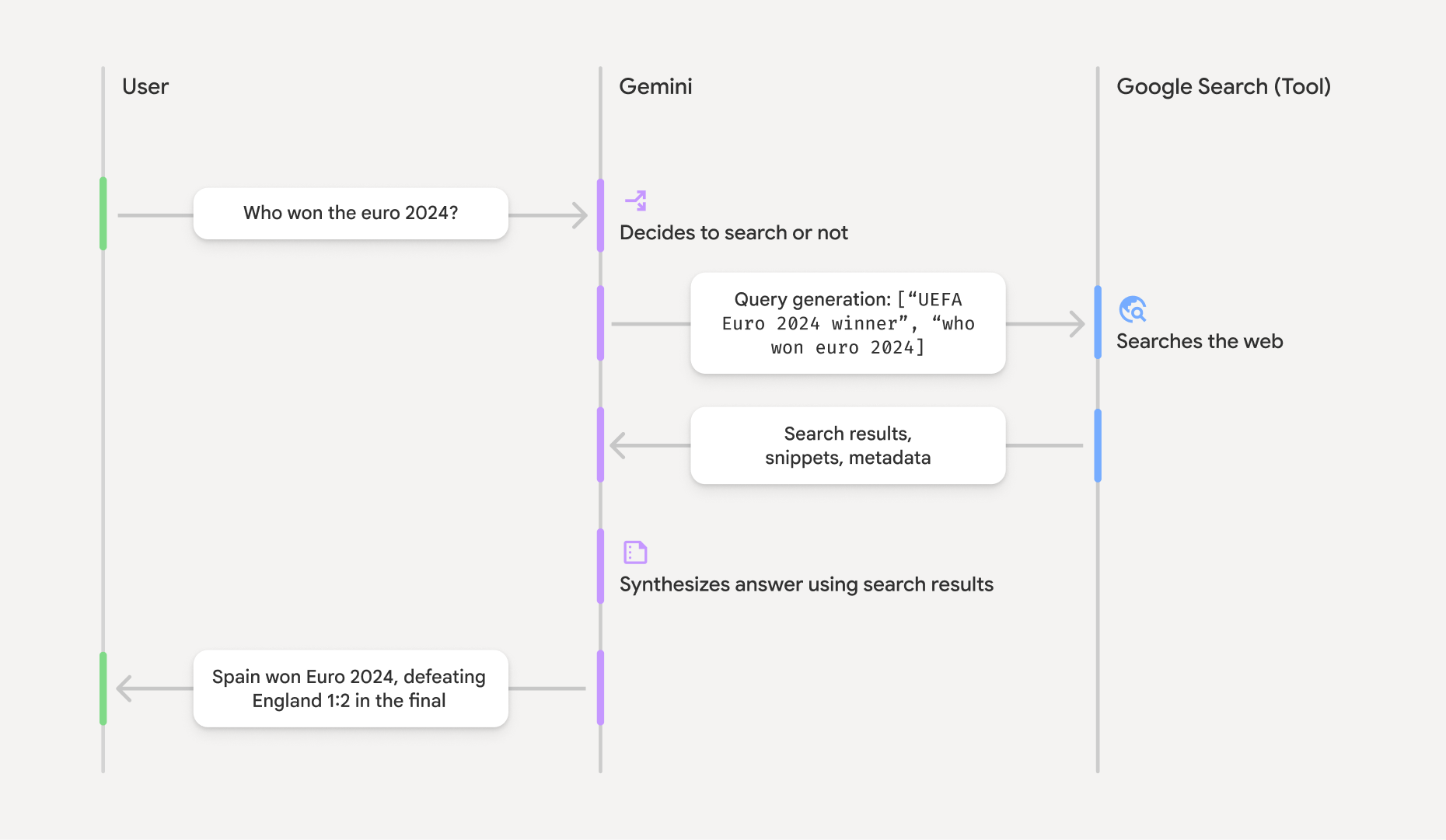
- Nutzer-Prompt:Ihre Anwendung sendet einen Nutzer-Prompt an die Gemini API, wobei das
google_search-Tool aktiviert ist. - Prompt-Analyse:Das Modell analysiert den Prompt und ermittelt, ob eine Google-Suche die Antwort verbessern kann.
- Google Suche:Bei Bedarf generiert das Modell automatisch eine oder mehrere Suchanfragen und führt sie aus.
- Verarbeitung der Suchergebnisse:Das Modell verarbeitet die Suchergebnisse, fasst die Informationen zusammen und formuliert eine Antwort.
- Fundierte Antwort:Die API gibt eine endgültige, nutzerfreundliche Antwort zurück, die auf den Suchergebnissen basiert. Diese Antwort enthält die Textantwort des Modells mit Inline-
annotations, die die Quellenangaben enthalten, sowie die Schrittegoogle_search_callundgoogle_search_resultmit den Suchanfragen und Suchvorschlägen.
Antworten auf Grundlage von Kontext verstehen
Wenn eine Antwort erfolgreich fundiert ist, enthält die Textausgabe des Modells Inline-annotations direkt im Textinhaltsblock. Diese Anmerkungen enthalten Zitationsinformationen, die Teile der Antwort mit ihren Quellen verknüpfen.
{
  "steps": [
    {
      "type": "thought",
      "summary": [
        {
          "type": "text",
          "text": "The user is asking for the winner of Euro 2024. I need to search for the result of the Euro 2024 final."
        }
      ],
      "signature": "CoMDAXLI2nynRYojJIy6B1Jh9os2crpWLfB0..."
    },
    {
      "type": "google_search_call",
      "arguments": {
        "queries": ["UEFA Euro 2024 winner"]
      }
    },
    {
      "type": "google_search_result",
      "call_id": "search_001",
      "result": [
        {
          "search_suggestions": "<!-- HTML and CSS for the search widget -->"
        }
      ]
    },
    {
      "type": "model_output",
      "content": [
        {
          "type": "text",
          "text": "Spain won Euro 2024, defeating England 2-1 in the final. This victory marks Spain's record fourth European Championship title.",
          "annotations": [
            {
              "type": "url_citation",
              "url": "https://www.aljazeera.com/sports/euro-2024-final",
              "title": "aljazeera.com",
              "start_index": 0,
              "end_index": 56
            },
            {
              "type": "url_citation",
              "url": "https://www.uefa.com/euro2024/news/spain-wins-euro-2024",
              "title": "uefa.com",
              "start_index": 57,
              "end_index": 124
            }
          ]
        }
      ]
    }
  ]
}
Die wichtigsten Felder in der Antwort:
google_search_call: Enthält die Suchequeries, die vom Modell ausgeführt wurde.google_search_result: Enthältsearch_suggestions, ein HTML-Snippet zum Rendern von Suchvorschlägen in Ihrer Benutzeroberfläche. Die vollständigen Nutzungsbedingungen finden Sie hier.textmitannotations: Die synthetisierte Antwort des Modells mit Inline-Zitaten. Jedeurl_citation-Anmerkung verknüpft ein Textsegment (definiert durchstart_indexundend_index) mit einer Quell-URL. Das ist der Schlüssel zum Erstellen von Inline-Zitaten.
Die Fundierung mit der Google Suche kann auch in Kombination mit dem URL-Kontexttool verwendet werden, um Antworten sowohl auf öffentlichen Webdaten als auch auf den von Ihnen angegebenen URLs zu fundieren.
Quellen mit Inline-Zitaten angeben
Die API gibt Inline-url_citation-Anmerkungen für den Textinhaltsblock zurück. So haben Sie die vollständige Kontrolle darüber, wie Sie Quellen in Ihrer Benutzeroberfläche anzeigen.
Jede Anmerkung enthält start_index und end_index, um anzugeben, auf welchen Teil des Textes sie sich bezieht. So können Sie sie extrahieren und anzeigen lassen.
Python
for step in interaction.steps:
    if step.type == "model_output":
        for content_block in step.content:
            if content_block.type == "text":
                print(content_block.text)
                if content_block.annotations:
                    print("\nCitations:")
                    for annotation in content_block.annotations:
                        if annotation.type == "url_citation":
                            cited_text = content_block.text[annotation.start_index:annotation.end_index]
                            print(f"  [{annotation.title}]({annotation.url})")
                            print(f"    Cited text: \"{cited_text}\"")
JavaScript
for (const step of interaction.steps) {
  if (step.type === 'model_output') {
    for (const contentBlock of step.content) {
      if (contentBlock.type === 'text') {
        console.log(contentBlock.text);
        if (contentBlock.annotations) {
          console.log("\nCitations:");
          for (const annotation of contentBlock.annotations) {
            if (annotation.type === 'url_citation') {
              const citedText = contentBlock.text.slice(annotation.startIndex, annotation.endIndex);
              console.log(`  [${annotation.title}](${annotation.url})`);
              console.log(`    Cited text: "${citedText}"`);
            }
          }
        }
      }
    }
  }
}
Java
import com.google.genai.Client;
import com.google.genai.gaos.models.interactions.Annotation;
import com.google.genai.gaos.models.interactions.Content;
import com.google.genai.gaos.models.interactions.CreateModelInteraction;
import com.google.genai.gaos.models.interactions.GoogleSearch;
import com.google.genai.gaos.models.interactions.Interaction;
import com.google.genai.gaos.models.interactions.InteractionsInput;
import com.google.genai.gaos.models.interactions.Model;
import com.google.genai.gaos.models.interactions.ModelOutputStep;
import com.google.genai.gaos.models.interactions.Step;
import com.google.genai.gaos.models.interactions.TextContent;
import com.google.genai.gaos.models.interactions.URLCitation;
import com.google.genai.gaos.models.operations.CreateInteractionRequestBody;
import java.util.Arrays;

Client client = new Client();

CreateModelInteraction params =
    CreateModelInteraction.builder()
        .model(Model.of("gemini-3.8-flash"))
        .input(InteractionsInput.of("Who won the euro 2024?"))
        .tools(Arrays.asList(GoogleSearch.builder().build()))
        .build();

Interaction interaction =
    client.interactions.create(CreateInteractionRequestBody.of(params)).interaction().get();

if (interaction.steps().isPresent()) {
  for (Step step : interaction.steps().get()) {
    if (step instanceof ModelOutputStep) {
      ModelOutputStep outputStep = (ModelOutputStep) step;
      if (outputStep.content().isPresent()) {
        for (Content contentBlock : outputStep.content().get()) {
          if (contentBlock instanceof TextContent) {
            TextContent textContent = (TextContent) contentBlock;
            String text = textContent.text().orElse("");
            System.out.println(text);
            if (textContent.annotations().isPresent()
                && !textContent.annotations().get().isEmpty()) {
              System.out.println("\nCitations:");
              for (Annotation annotation : textContent.annotations().get()) {
                if (annotation instanceof URLCitation) {
                  URLCitation citation = (URLCitation) annotation;
                  int start = citation.startIndex().orElse(0);
                  int end = citation.endIndex().orElse(0);
                  String citedText =
                      (start >= 0 && end <= text.length() && start <= end)
                          ? text.substring(start, end)
                          : "";
                  System.out.printf(
                      "  [%s](%s)%n", citation.title().orElse(""), citation.url().orElse(""));
                  System.out.printf("    Cited text: \"%s\"%n", citedText);
                }
              }
            }
          }
        }
      }
    }
  }
}
Ok
package main

import (
    "context"
    "fmt"
    "log"

    "google.golang.org/genai"
    "google.golang.org/genai/interactions/models/interactions"
    "google.golang.org/genai/interactions/models/operations"
)

func main() {
    ctx := context.Background()
    client, err := genai.NewClient(ctx, nil)
    if err != nil {
        log.Fatal(err)
    }

    resp, err := client.Interactions.Create(ctx, operations.CreateInteractionRequest{
        Body: operations.NewCreateInteractionRequestBody(
            interactions.CreateModelInteraction{
                Model: interactions.Model("gemini-3.8-flash"),
                Input: interactions.NewInteractionsInput("Who won the euro 2024?"),
                Tools: []interactions.Tool{
                    interactions.NewTool(interactions.GoogleSearch{}),
                },
            },
        ),
    })
    if err != nil {
        log.Fatal(err)
    }

    for _, step := range resp.Interaction.Steps {
        if step.ModelOutputStep != nil {
            for _, content := range step.ModelOutputStep.Content {
                if content.TextContent != nil {
                    text := content.TextContent.Text
                    fmt.Println(text)
                    if len(content.TextContent.Annotations) > 0 {
                        fmt.Println("\nCitations:")
                        for _, annotation := range content.TextContent.Annotations {
                            if annotation.URLCitation != nil {
                                c := annotation.URLCitation
                                start := 0
                                if c.StartIndex != nil {
                                    start = *c.StartIndex
                                }
                                end := 0
                                if c.EndIndex != nil {
                                    end = *c.EndIndex
                                }
                                citedText := ""
                                if start >= 0 && end <= len(text) && start <= end {
                                    citedText = text[start:end]
                                }
                                title := ""
                                if c.Title != nil {
                                    title = *c.Title
                                }
                                url := ""
                                if c.URL != nil {
                                    url = *c.URL
                                }
                                fmt.Printf("  [%s](%s)\n", title, url)
                                fmt.Printf("    Cited text: %q\n", citedText)
                            }
                        }
                    }
                }
            }
        }
    }
}
In der Ausgabe wird der Text gefolgt von den zugehörigen Quellenangaben angezeigt:
Spain won Euro 2024, defeating England 2-1 in the final. This victory marks Spain's record fourth European Championship title.

Citations:
  [aljazeera.com](https://www.aljazeera.com/sports/euro-2024-final)
    Cited text: "Spain won Euro 2024, defeating England 2-1 in the final."
  [uefa.com](https://www.uefa.com/euro2024/news/spain-wins-euro-2024)
    Cited text: "This victory marks Spain's record fourth European Championship title."
Preise
Wenn Sie Fundierung mit der Google Suche mit Gemini 3 verwenden, wird Ihr Projekt für jede Suchanfrage abgerechnet, die das Modell ausführt. Wenn das Modell mehrere Suchanfragen ausführt, um eine einzelne Aufforderung zu beantworten (z. B. wenn innerhalb desselben API-Aufrufs nach "UEFA Euro 2024 winner" und "Spain vs England Euro 2024 final
score" gesucht wird), zählt dies für diese Anfrage als zwei abrechenbare Nutzungen des Tools. Für Abrechnungszwecke werden leere Websuchanfragen beim Zählen eindeutiger Anfragen ignoriert. Dieses Abrechnungsmodell gilt nur für Gemini 3-Modelle. Wenn Sie die Fundierung mit der Google Suche mit Gemini 2.5 oder älteren Modellen verwenden, wird Ihr Projekt pro Prompt abgerechnet.
Ausführliche Preisinformationen finden Sie auf der Seite Gemini API-Preise.
Unterstützte Modelle
Eine vollständige Liste der Funktionen finden Sie auf der Seite Modellübersicht.
| Modell | Fundierung mit der Google Suche |
|---|---|
| Gemini 3.8 Flash | ✔️ |
| Gemini 3.7 Flash | ✔️ |
| Gemini 3.6 Flash | ✔️ |
| Gemini 3.5 Flash-Lite | ✔️ |
| Gemini 3.5 Flash | ✔️ |
| Gemini 3.1 Flash Image (Vorabversion) | ✔️ |
| Gemini 3.1 Pro (Vorabversion) | ✔️ |
| Gemini 3 Pro Image (Vorabversion) | ✔️ |
| Gemini 3 Flash (Vorabversion) | ✔️ |
| Gemini 2.5 Pro | ✔️ |
| Gemini 2.5 Flash | ✔️ |
| Gemini 2.5 Flash-Lite | ✔️ |
| Gemini 2.0 Flash | ✔️ |
Unterstützte Tool-Kombinationen
Sie können die Fundierung mit der Google Suche mit anderen Tools wie Code-Ausführung, URL-Kontext und Fundierung mit Google Maps (unterstützt in Gemini 3.5 Flash und späteren Modellen) kombinieren, um komplexere Anwendungsfälle zu ermöglichen. Gemini 3-Modelle unterstützen auch die Kombination dieser integrierten Tools mit benutzerdefinierten Tools (Funktionsaufruf). Weitere Informationen zu Tool-Kombinationen