

 Ver en ai.google.dev Ver en ai.google.dev
|
 Ejecutar en Google Colab Ejecutar en Google Colab
|
 Ejecutar en Kaggle Ejecutar en Kaggle
|
 Abrir en Vertex AI Abrir en Vertex AI
|
 Ver el código fuente en GitHub Ver el código fuente en GitHub
|
Gemma es una familia de modelos abiertos, livianos y de última generación creados a partir de la misma investigación y tecnología que se utilizaron para crear los modelos de Gemini. Gemma 4 está diseñada para ser la familia de modelos de código abierto más eficiente del mundo.
En este documento, se muestra cómo usar las capacidades de pensamiento de Gemma 4 para generar procesos de razonamiento antes de proporcionar una respuesta final. Aprenderás a habilitar el modo de pensamiento para tareas de solo texto y multimodales (imagen y texto) con la biblioteca transformers de Hugging Face, y a analizar el resultado para separar el pensamiento de la respuesta.
Este notebook se ejecutará en la GPU T4.
Instala paquetes de Python
Instala las bibliotecas de Hugging Face necesarias para ejecutar el modelo de Gemma y realizar solicitudes.
# Install PyTorch & other librariespip install torch accelerate# Install the transformers librarypip install transformers
Cargar modelo
Usa las bibliotecas de transformers para crear una instancia de processor y model con las clases AutoProcessor y AutoModelForImageTextToText, como se muestra en el siguiente ejemplo de código:
MODEL_ID = "google/gemma-4-E2B-it" # @param ["google/gemma-4-E2B-it","google/gemma-4-E4B-it", "google/gemma-4-31B-it", "google/gemma-4-26B-A4B-it"]

from transformers import AutoProcessor, AutoModelForMultimodalLM

model = AutoModelForMultimodalLM.from_pretrained(MODEL_ID, dtype="auto", device_map="auto")
processor = AutoProcessor.from_pretrained(MODEL_ID)
Loading weights: 0%| | 0/2011 [00:00<?, ?it/s]
Una sola inferencia de texto con Thinking
Para generar una respuesta con las capacidades de razonamiento del modelo, pasa enable_thinking=True. El procesador insertará los tokens de razonamiento correctos en la instrucción, lo que le indicará al modelo que piense antes de responder.
| Tamaño del modelo | Estado de pensamiento | Estructura y salida de la plantilla |
|---|---|---|
| E2B/E4B | OFF | <|turn>user\n[Prompt]<turn|>\n<|turn>model |
| E2B/E4B | ACTIVADO | <|turn>system\n<|think|><turn|>\n<|turn>user\n[Prompt]<turn|>\n<|turn>model |
| 26B/31B | OFF | ⚠️ <|turn>user\n[Prompt]<turn|>\n<|turn>model\n<|channel>thought\n<channel|> |
| 26B/31B | ACTIVADO | <|turn>system\n<|think|><turn|>\n<|turn>user\n[Prompt]<turn|>\n<|turn>model |
from transformers import TextStreamer

message = [
    {
        "role": "user", "content": "What is the water formula?"
    }
]

text = processor.apply_chat_template(message, tokenize=False, add_generation_prompt=True, enable_thinking=True)
inputs = processor(text=text, return_tensors="pt").to(model.device)
input_len = inputs["input_ids"].shape[-1]

streamer = TextStreamer(processor)
outputs = model.generate(**inputs, streamer=streamer, max_new_tokens=1024)
<bos><|turn>system
<|think|><turn|>
<|turn>user
What is the water formula?<turn|>
<|turn>model
<|channel>thought
Thinking Process:

1.  **Analyze the Request:** The user is asking, "What is the water formula?"
2.  **Interpret the Ambiguity:** The term "water formula" is highly ambiguous. It could refer to several things:
    *   **Chemical Formula:** \\(\text{H}_2\text{O}\\) (the molecular formula).
    *   **Physical/Scientific Formula:** The properties of water (e.g., polarity, hydrogen bonding, specific heat).
    *   **Biological/Chemical Formula:** The role of water in biochemistry (e.g., solvation, hydration shells).
    *   **Mathematical Formula:** Equations relating to water cycles, thermodynamics, or fluid dynamics.
    *   **Culinary/Recipe Formula:** A specific recipe.
    *   **A specific context missing:** Is this related to chemistry, physics, biology, engineering, or something else?
3.  **Determine the Most Likely Interpretation:** In a general knowledge context, when someone asks for a "formula" related to water, they most often mean the fundamental chemical structure.
4.  **Formulate the Primary Answer (Chemical):** State the chemical formula and briefly explain what it represents.
5.  **Address the Ambiguity (Provide Context/Alternatives):** Since the request is vague, offer other possible interpretations so the user can clarify.
6.  **Review Constraints (Self-Correction/Identity Check):** I am Gemma 4, an LLM. I can provide factual information based on my knowledge base. No tools are needed. The answer should be clear and comprehensive.

7.  **Draft the Response Structure:**
    *   Start with the most direct answer (Chemical Formula).
    *   Explain the components and bonding.
    *   Offer context for other possible meanings. (Drafting the final response based on this structure.)<channel|>The term "water formula" can be interpreted in several ways, depending on the context (chemistry, physics, biology, etc.).

Here are the most common interpretations:

### 1. Chemical Formula (The Most Common Answer)

The fundamental chemical formula for water is:


$$\text{H}_2\text{O}$$


*   **H** represents the element **Hydrogen**.
*   **O** represents the element **Oxygen**.

This formula indicates that one molecule of water is composed of two hydrogen atoms covalently bonded to one oxygen atom.

### 2. Molecular Structure and Bonding

Beyond the formula, the "formula" also describes how the atoms interact:

*   **Polarity:** Water is a highly **polar** molecule. Oxygen is much more electronegative than hydrogen, meaning it pulls the shared electrons closer to itself. This creates a partial negative charge (\\(\delta^-\\)) on the oxygen atom and partial positive charges (\\(\delta^+\\)) on the hydrogen atoms.
*   **Hydrogen Bonding:** The polarity allows water molecules to form **hydrogen bonds** with each other. This strong attraction is responsible for water's unique physical properties, such as its high specific heat, its ability to dissolve many substances (its role as a universal solvent), and its high surface tension.

### 3. Formula in Physics/Thermodynamics

If you are referring to a physical formula, it might relate to:

*   **Specific Heat Capacity:** The amount of energy required to raise the temperature of a given mass of water by one degree.
*   **Density and Volume:** Equations relating the mass, volume, and density of water under different temperatures and pressures.

***

**In summary, if you are asking for the basic chemical makeup, the formula is \\(\text{H}_2\text{O}\\).**

If you are looking for a specific formula in a different field (like a mathematical equation or a biological reaction), please provide more context!<turn|>
Una vez que se genera el texto, la respuesta contendrá los bloques de razonamiento y la respuesta final delimitada por tokens especiales. Puedes usar la utilidad parse_response para extraerlos fácilmente en un diccionario que contenga thinking y answer.
response = processor.decode(outputs[0][input_len:], skip_special_tokens=False)
result = processor.parse_response(response)

for key, value in result.items():
  if key == "role":
    print(f"Role: {value}")
  elif key == "thinking":
    print(f"\n=== Thoughts ===\n{value}")
  elif key == "content":
    print(f"\n=== Answer ===\n{value}")
  elif key == "tool_calls":
    print(f"\n=== Tool Calls ===\n{value}")
  else:
    print(f"\n{key}: {value}...\n")
Role: assistant

=== Thoughts ===
Thinking Process:

1.  **Analyze the Request:** The user is asking, "What is the water formula?"
2.  **Interpret the Ambiguity:** The term "water formula" is highly ambiguous. It could refer to several things:
    *   **Chemical Formula:** \\(\text{H}_2\text{O}\\) (the molecular formula).
    *   **Physical/Scientific Formula:** The properties of water (e.g., polarity, hydrogen bonding, specific heat).
    *   **Biological/Chemical Formula:** The role of water in biochemistry (e.g., solvation, hydration shells).
    *   **Mathematical Formula:** Equations relating to water cycles, thermodynamics, or fluid dynamics.
    *   **Culinary/Recipe Formula:** A specific recipe.
    *   **A specific context missing:** Is this related to chemistry, physics, biology, engineering, or something else?
3.  **Determine the Most Likely Interpretation:** In a general knowledge context, when someone asks for a "formula" related to water, they most often mean the fundamental chemical structure.
4.  **Formulate the Primary Answer (Chemical):** State the chemical formula and briefly explain what it represents.
5.  **Address the Ambiguity (Provide Context/Alternatives):** Since the request is vague, offer other possible interpretations so the user can clarify.
6.  **Review Constraints (Self-Correction/Identity Check):** I am Gemma 4, an LLM. I can provide factual information based on my knowledge base. No tools are needed. The answer should be clear and comprehensive.

7.  **Draft the Response Structure:**
    *   Start with the most direct answer (Chemical Formula).
    *   Explain the components and bonding.
    *   Offer context for other possible meanings. (Drafting the final response based on this structure.)

=== Answer ===
The term "water formula" can be interpreted in several ways, depending on the context (chemistry, physics, biology, etc.).

Here are the most common interpretations:

### 1. Chemical Formula (The Most Common Answer)

The fundamental chemical formula for water is:


$$\text{H}_2\text{O}$$


*   **H** represents the element **Hydrogen**.
*   **O** represents the element **Oxygen**.

This formula indicates that one molecule of water is composed of two hydrogen atoms covalently bonded to one oxygen atom.

### 2. Molecular Structure and Bonding

Beyond the formula, the "formula" also describes how the atoms interact:

*   **Polarity:** Water is a highly **polar** molecule. Oxygen is much more electronegative than hydrogen, meaning it pulls the shared electrons closer to itself. This creates a partial negative charge (\\(\delta^-\\)) on the oxygen atom and partial positive charges (\\(\delta^+\\)) on the hydrogen atoms.
*   **Hydrogen Bonding:** The polarity allows water molecules to form **hydrogen bonds** with each other. This strong attraction is responsible for water's unique physical properties, such as its high specific heat, its ability to dissolve many substances (its role as a universal solvent), and its high surface tension.

### 3. Formula in Physics/Thermodynamics

If you are referring to a physical formula, it might relate to:

*   **Specific Heat Capacity:** The amount of energy required to raise the temperature of a given mass of water by one degree.
*   **Density and Volume:** Equations relating the mass, volume, and density of water under different temperatures and pressures.

***

**In summary, if you are asking for the basic chemical makeup, the formula is \\(\text{H}_2\text{O}\\).**

If you are looking for a specific formula in a different field (like a mathematical equation or a biological reaction), please provide more context!
Una inferencia de imagen única
El procedimiento para usar el modelo de pensamiento con datos visuales es muy similar. Puedes proporcionar una imagen como parte del array messages. Solo asegúrate de pasar la imagen al procesador junto con el texto con formato, y el modelo razonará sobre la entrada visual antes de responder.
from PIL import Image
import matplotlib.pyplot as plt

prompt = "What is shown in this image?"
image_url = "https://raw.githubusercontent.com/google-gemma/cookbook/refs/heads/main/Demos/sample-data/GoldenGate.png"

# download image
!wget -q {image_url} -O image.png
image = Image.open("image.png")

# Display all images
print("=== Downloaded image ===")
fig, ax = plt.subplots(1, 1, figsize=(5, 5))
ax.imshow(image)
ax.set_title("Image 1")
ax.axis("off")
plt.tight_layout()
plt.show()

message = [
    {
        "role": "user", "content": [
          {"type": "image"},
          {"type": "text", "text": prompt}
        ]
    }
]

text = processor.apply_chat_template(message, tokenize=False, add_generation_prompt=True, enable_thinking=True)
inputs = processor(text=text, images=image, return_tensors="pt").to(model.device)
input_len = inputs["input_ids"].shape[-1]

outputs = model.generate(**inputs, max_new_tokens=1024)
response = processor.decode(outputs[0][input_len:], skip_special_tokens=False)

result = processor.parse_response(response)

for key, value in result.items():
  if key == "role":
    print(f"Role: {value}")
  elif key == "thinking":
    print(f"\n=== Thoughts ===\n{value}")
  elif key == "content":
    print(f"\n=== Answer ===\n{value}")
  elif key == "tool_calls":
    print(f"\n=== Tool Calls ===\n{value}")
  else:
    print(f"\n{key}: {value}...\n")
=== Downloaded image ===
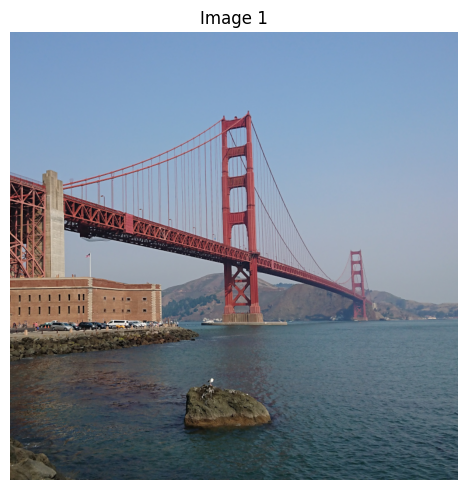
Role: assistant

=== Thoughts ===
Here's a thinking process to arrive at the suggested description:

1.  **Analyze the Image Content:**
    *   **Dominant Feature:** A large suspension bridge with distinctive red/orange trusswork. This is immediately recognizable as the Golden Gate Bridge.
    *   **Setting:** Water (a large body of water, likely the bay/ocean).
    *   **Foreground/Midground:**
        *   Water in the immediate foreground (dark blue/green).
        *   A rocky outcrop/island in the middle foreground.
        *   A substantial stone/brick structure to the left (part of the bridge approach or a related structure).
    *   **Background:** Hazy landmasses/hills behind the bridge.
    *   **Sky:** Clear, light blue sky.
    *   **Atmosphere/Lighting:** Bright daylight, clear weather.

2.  **Identify Key Elements for Description:**
    *   The Bridge (Golden Gate Bridge).
    *   The Water/Bay.
    *   The Coastal/Land features.

3.  **Draft the Description (Focusing on detail and clarity):**
    *   *Initial thought:* It's a picture of the Golden Gate Bridge over the water.
    *   *Refinement (Adding detail):* The image shows the iconic red suspension bridge spanning a body of water. There is a rocky island in the foreground and some structures on the shore.
    *   *Enhancement (Adding context and visual appeal):* Mention the color, the scale, and the atmosphere.

4.  **Final Polish and Structure (Grouping similar ideas):** (This leads to the final structured response.)

    *   *Identification:* State clearly what the main subject is.
    *   *Setting:* Describe the environment (water, sky).
    *   *Details:* Mention specific foreground and background elements.

5.  **Review against the original prompt:** (The prompt asks "What is shown in this image?") The description accurately reflects the visual evidence. (Self-Correction: Ensure the identification is confident, which it is, based on the structure and color.)

=== Answer ===
This image shows the **Golden Gate Bridge** spanning a body of water, likely the San Francisco Bay.

Here is a breakdown of what is visible:

* **The Golden Gate Bridge:** The iconic red/orange suspension bridge dominates the frame, stretching across the water. Its distinctive structure and massive towers are clearly visible.
* **Water:** A large expanse of blue-green water fills the foreground and midground.
* **Foreground Elements:** In the immediate foreground, there is a dark, rocky outcrop or small island.
* **Shoreline/Structures:** To the left, there are stone and brick structures, suggesting the land or approach to the bridge.
* **Background:** Hazy hills or landmasses are visible in the distance behind the bridge.
* **Atmosphere:** The scene is brightly lit under a clear, light blue sky, suggesting fair weather.

In summary, it is a scenic photograph capturing the majestic view of the Golden Gate Bridge.
Resumen y próximos pasos
En esta guía, aprendiste a usar las capacidades de pensamiento de los modelos de Gemma 4 para generar procesos de razonamiento antes de las respuestas finales. Se abordaron estos temas:
- Habilita el modo de pensamiento con
enable_thinking=Trueenapply_chat_template. - Usar
TextStreamerpara observar el proceso de pensamiento en tiempo real - Analiza el resultado combinado en bloques
thinkingyanswerseparados conparse_response. - Aplicar capacidades de pensamiento a tareas multimodales (imagen y texto)
Próximos pasos
Explora más capacidades de Gemma 4: