

Búsqueda de archivos
La API de Gemini habilita la generación mejorada por recuperación ("RAG") a través de la herramienta de búsqueda de archivos. La Búsqueda de archivos importa, divide en fragmentos y, luego, indexa tus datos para permitir la recuperación rápida de información pertinente según una instrucción proporcionada. Luego, esta información recuperada se usa como contexto para el modelo, lo que le permite proporcionar respuestas más precisas y pertinentes. La búsqueda de archivos también puede proporcionar capacidades multimodales con incorporaciones de texto compatibles con gemini-embedding-001 y con incorporaciones de imágenes o multimodales compatibles con gemini-embedding-2.
El almacenamiento de archivos y la generación de embeddings en el momento de la búsqueda son gratuitos, y solo pagarás por crear embeddings cuando indexes tus archivos por primera vez y por el costo normal de los tokens de entrada y salida del modelo de Gemini. Este nuevo paradigma de facturación hace que la herramienta de búsqueda de archivos sea más fácil y rentable de desarrollar y escalar. Consulta la sección de precios para obtener más detalles.
Subir directamente a la tienda de Búsqueda de archivos
En este ejemplo, se muestra cómo subir directamente un archivo al almacén de búsqueda de archivos:
Python
# This will only work for SDK newer than 2.0.0
from google import genai
from google.genai import types
import time

client = genai.Client()

# File name will be visible in citations
file_search_store = client.file_search_stores.create(
    config={
        'display_name': 'your-fileSearchStore-name',
        'embedding_model': 'models/gemini-embedding-2'
    }
)

operation = client.file_search_stores.upload_to_file_search_store(
  file='sample.txt',
  file_search_store_name=file_search_store.name,
  config={
      'display_name' : 'display-file-name',
  }
)

while not operation.done:
    time.sleep(5)
    operation = client.operations.get(operation)

interaction = client.interactions.create(
    model="gemini-3-flash-preview",
    input="Can you tell me about [insert question]",
    tools=[{
        "type": "file_search",
        "file_search_store_names": [file_search_store.name]
    }]
)

for step in interaction.steps:
    if step.type == "model_output":
        for content_block in step.content:
            if content_block.type == "text":
                print(content_block.text)
                if content_block.annotations:
                    print("\nSources:")
                    for annotation in content_block.annotations:
                        if annotation.type == "file_citation":
                            print(f"  - {annotation.file_name}: {annotation.source}")
JavaScript
// This will only work for SDK newer than 2.0.0
const { GoogleGenAI } = require('@google/genai');

const ai = new GoogleGenAI({});

async function run() {
  // File name will be visible in citations
  const fileSearchStore = await ai.fileSearchStores.create({
    config: {
      displayName: 'your-fileSearchStore-name',
      embeddingModel: 'models/gemini-embedding-2'
    }
  });

  let operation = await ai.fileSearchStores.uploadToFileSearchStore({
    file: 'file.txt',
    fileSearchStoreName: fileSearchStore.name,
    config: {
      displayName: 'file-name',
    }
  });

  while (!operation.done) {
    await new Promise(resolve => setTimeout(resolve, 5000));
    operation = await ai.operations.get({ operation });
  }

  const interaction = await ai.interactions.create({
    model: "gemini-3-flash-preview",
    input: "Can you tell me about [insert question]",
    tools: [{
      type: "file_search",
      file_search_store_names: [fileSearchStore.name]
    }]
  });

  for (const step of interaction.steps) {
    if (step.type === 'model_output') {
      for (const contentBlock of step.content) {
        if (contentBlock.type === 'text') {
          console.log(contentBlock.text);
          if (contentBlock.annotations) {
            console.log("\nSources:");
            for (const annotation of contentBlock.annotations) {
              if (annotation.type === 'file_citation') {
                console.log(`  - ${annotation.file_name}: ${annotation.source}`);
              }
            }
          }
        }
      }
    }
  }
}

run();
Consulta la referencia de la API de uploadToFileSearchStore para obtener más información.
Importación de archivos
También puedes subir un archivo existente y importarlo a tu tienda de búsqueda de archivos:
Python
# This will only work for SDK newer than 2.0.0
from google import genai
from google.genai import types
import time

client = genai.Client()

# File name will be visible in citations
sample_file = client.files.upload(file='sample.txt', config={'display_name': 'display_file_name'})

file_search_store = client.file_search_stores.create(
    config={
        'display_name': 'your-fileSearchStore-name',
        'embedding_model': 'models/gemini-embedding-2'
    }
)

operation = client.file_search_stores.import_file(
    file_search_store_name=file_search_store.name,
    file_name=sample_file.name
)

while not operation.done:
    time.sleep(5)
    operation = client.operations.get(operation)

interaction = client.interactions.create(
    model="gemini-3-flash-preview",
    input="Can you tell me about [insert question]",
    tools=[{
        "type": "file_search",
        "file_search_store_names": [file_search_store.name]
    }]
)

for step in interaction.steps:
    if step.type == "model_output":
        for content_block in step.content:
            if content_block.type == "text":
                print(content_block.text)
JavaScript
// This will only work for SDK newer than 2.0.0
const { GoogleGenAI } = require('@google/genai');

const ai = new GoogleGenAI({});

async function run() {
  // File name will be visible in citations
  const sampleFile = await ai.files.upload({
    file: 'sample.txt',
    config: { displayName: 'file-name' }
  });

  const fileSearchStore = await ai.fileSearchStores.create({
    config: {
      displayName: 'your-fileSearchStore-name',
      embeddingModel: 'models/gemini-embedding-2'
    }
  });

  let operation = await ai.fileSearchStores.importFile({
    fileSearchStoreName: fileSearchStore.name,
    fileName: sampleFile.name
  });

  while (!operation.done) {
    await new Promise(resolve => setTimeout(resolve, 5000));
    operation = await ai.operations.get({ operation: operation });
  }

  const interaction = await ai.interactions.create({
    model: "gemini-3-flash-preview",
    input: "Can you tell me about [insert question]",
    tools: [{
      type: "file_search",
      file_search_store_names: [fileSearchStore.name]
    }]
  });

  for (const step of interaction.steps) {
    if (step.type === 'model_output') {
      for (const contentBlock of step.content) {
        if (contentBlock.type === 'text') {
          console.log(contentBlock.text);
        }
      }
    }
  }
}

run();
Consulta la referencia de la API de importFile para obtener más información.
Configuración de fragmentación
Cuando importas un archivo a un almacén de File Search, se divide automáticamente en fragmentos, se incorpora, se indexa y se sube a tu almacén de File Search. Si necesitas más control sobre la estrategia de fragmentación, puedes especificar un parámetro de configuración chunking_config para establecer una cantidad máxima de tokens por fragmento y una cantidad máxima de tokens superpuestos.
Python
# This will only work for SDK newer than 2.0.0
from google import genai
from google.genai import types
import time

client = genai.Client()

operation = client.file_search_stores.upload_to_file_search_store(
    file_search_store_name=file_search_store.name,
    file='sample.txt',
    config={
        'chunking_config': {
          'white_space_config': {
            'max_tokens_per_chunk': 200,
            'max_overlap_tokens': 20
          }
        }
    }
)

while not operation.done:
    time.sleep(5)
    operation = client.operations.get(operation)

print("Custom chunking complete.")
JavaScript
// This will only work for SDK newer than 2.0.0
const { GoogleGenAI } = require('@google/genai');

const ai = new GoogleGenAI({});

let operation = await ai.fileSearchStores.uploadToFileSearchStore({
  file: 'file.txt',
  fileSearchStoreName: fileSearchStore.name,
  config: {
    displayName: 'file-name',
    chunkingConfig: {
      whiteSpaceConfig: {
        maxTokensPerChunk: 200,
        maxOverlapTokens: 20
      }
    }
  }
});

while (!operation.done) {
  await new Promise(resolve => setTimeout(resolve, 5000));
  operation = await ai.operations.get({ operation });
}
console.log("Custom chunking complete.");
Para usar tu almacén de File Search, pásala como una herramienta al método interactions.create, como se muestra en los ejemplos de Upload y Import.
Cómo funciona
La Búsqueda de archivos usa una técnica llamada búsqueda semántica para encontrar información pertinente para la instrucción del usuario. A diferencia de la búsqueda estándar basada en palabras clave, la búsqueda semántica comprende el significado y el contexto de tu búsqueda.
Cuando importas un archivo, este se convierte en representaciones numéricas llamadas embeddings, que capturan el significado semántico del contenido subido. Estos embeddings se almacenan en una base de datos especializada de File Search. Cuando realizas una búsqueda, esta también se convierte en un embedding. Luego, el sistema realiza una búsqueda de archivos para encontrar los fragmentos de documentos más similares y relevantes del almacén de búsqueda de archivos.
No hay un tiempo de actividad (TTL) para las incorporaciones; estas persisten hasta que se borran de forma manual o cuando el modelo deja de estar disponible. Sin embargo, los archivos se borran después de 48 horas.
A continuación, se detalla el proceso para usar la API de File Search uploadToFileSearchStore:
Crea un almacén de búsqueda de archivos: Un almacén de búsqueda de archivos contiene los datos procesados de tus archivos. Es el contenedor persistente para los embeddings en los que operará la búsqueda semántica.
Sube un archivo y, luego, impórtalo a un almacén de File Search: Sube un archivo y, luego, importa los resultados a tu almacén de File Search de forma simultánea. Esto crea un objeto
Filetemporal, que es una referencia a tu documento sin procesar. Luego, esos datos se dividen en fragmentos, se convierten en incorporaciones de la Búsqueda de archivos y se indexan. El objetoFilese borra después de 48 horas, mientras que los datos importados en el almacén de la Búsqueda de archivos se almacenarán de forma indefinida hasta que decidas borrarlos.Consulta con la Búsqueda de archivos: Por último, usas la herramienta
FileSearchen una llamada agenerateContent. En la configuración de la herramienta, especificas unFileSearchRetrievalResource, que apunta alFileSearchStoreque deseas buscar. Esto le indica al modelo que realice una búsqueda semántica en ese almacén específico de File Search para encontrar información pertinente que fundamente su respuesta.
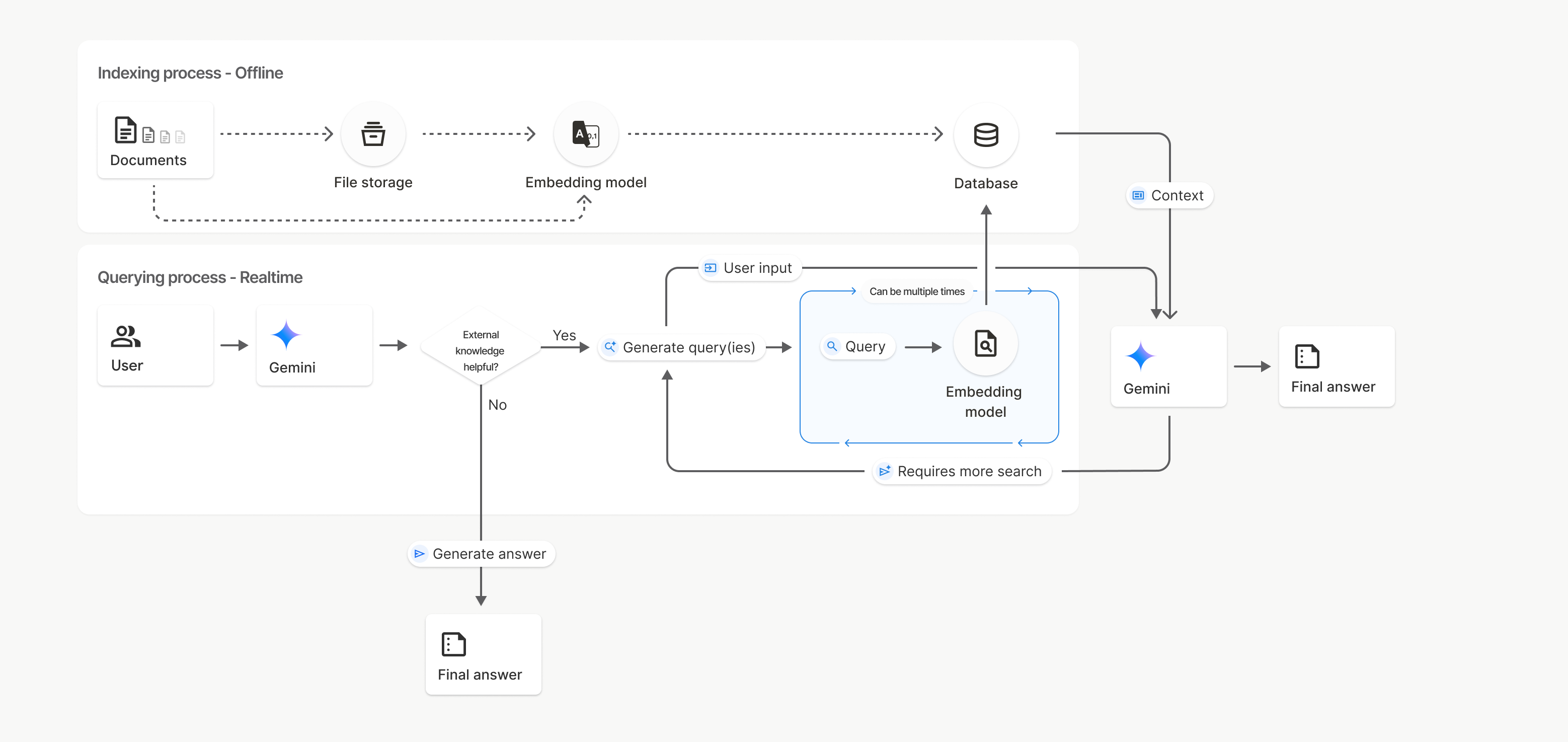
En este diagrama, la línea punteada de Documents a Embedding model (con gemini-embedding-001) representa la API de uploadToFileSearchStore (sin pasar por File storage).
De lo contrario, usar la API de Files para crear y, luego, importar archivos por separado traslada el proceso de indexación de Documents a File storage y, luego, a Embedding model.
Almacenes de búsqueda de archivos
Un almacén de File Search es un contenedor para los embeddings de tus documentos. Si bien los archivos sin procesar que se suben a través de la API de File se borran después de 48 horas, los datos que se importan a un almacén de File Search se almacenan de forma indefinida hasta que los borres de forma manual. Puedes crear varios almacenes de File Search para organizar tus documentos. La API de FileSearchStore te permite crear, enumerar, obtener y borrar para administrar tus tiendas de búsqueda de archivos. Los nombres de la tienda de Búsqueda de archivos tienen un alcance global.
Estos son algunos ejemplos de cómo administrar tus tiendas de Búsqueda de archivos:
Python
# This will only work for SDK newer than 2.0.0
file_search_store = client.file_search_stores.create(
    config={
        'display_name': 'my-file_search-store-123',
        'embedding_model': 'models/gemini-embedding-2'
    }
)

for file_search_store in client.file_search_stores.list():
    print(file_search_store)

my_file_search_store = client.file_search_stores.get(name='fileSearchStores/my-file_search-store-123')

client.file_search_stores.delete(name='fileSearchStores/my-file_search-store-123', config={'force': True})
JavaScript
// This will only work for SDK newer than 2.0.0
const fileSearchStore = await ai.fileSearchStores.create({
  config: {
    displayName: 'my-file_search-store-123',
    embeddingModel: 'models/gemini-embedding-2'
  }
});

const fileSearchStores = await ai.fileSearchStores.list();
for await (const store of fileSearchStores) {
  console.log(store);
}

const myFileSearchStore = await ai.fileSearchStores.get({
  name: 'fileSearchStores/my-file_search-store-123'
});

await ai.fileSearchStores.delete({
  name: 'fileSearchStores/my-file_search-store-123',
  config: { force: true }
});
REST
curl -X POST "https://generativelanguage.googleapis.com/v1beta/fileSearchStores?key=${GEMINI_API_KEY}" \
    -H "Content-Type: application/json" \
    -d '{ "displayName": "My Store", "embedding_model": "models/gemini-embedding-2" }'

curl "https://generativelanguage.googleapis.com/v1beta/fileSearchStores?key=${GEMINI_API_KEY}" \

curl "https://generativelanguage.googleapis.com/v1beta/fileSearchStores/my-file_search-store-123?key=${GEMINI_API_KEY}"

curl -X DELETE "https://generativelanguage.googleapis.com/v1beta/fileSearchStores/my-file_search-store-123?key=${GEMINI_API_KEY}"
Documentos de búsqueda de archivos
Puedes administrar documentos individuales en tus almacenes de archivos con la API de File Search Documents para list cada documento en un almacén de búsqueda de archivos, get información sobre un documento y delete un documento por nombre.
Python
# This will only work for SDK newer than 2.0.0
for document_in_store in client.file_search_stores.documents.list(parent='fileSearchStores/my-file_search-store-123'):
  print(document_in_store)

file_search_document = client.file_search_stores.documents.get(name='fileSearchStores/my-file_search-store-123/documents/my_doc')
print(file_search_document)

client.file_search_stores.documents.delete(name='fileSearchStores/my-file_search-store-123/documents/my_doc', config={'force': True})
JavaScript
// This will only work for SDK newer than 2.0.0
const documents = await ai.fileSearchStores.documents.list({
  parent: 'fileSearchStores/my-file_search-store-123'
});
for await (const doc of documents) {
  console.log(doc);
}

const fileSearchDocument = await ai.fileSearchStores.documents.get({
  name: 'fileSearchStores/my-file_search-store-123/documents/my_doc'
});

await ai.fileSearchStores.documents.delete({
  name: 'fileSearchStores/my-file_search-store-123/documents/my_doc'
});
REST
curl "https://generativelanguage.googleapis.com/v1beta/fileSearchStores/my-file_search-store-123/documents?key=${GEMINI_API_KEY}"

curl "https://generativelanguage.googleapis.com/v1beta/fileSearchStores/my-file_search-store-123/documents/my_doc?key=${GEMINI_API_KEY}"

curl -X DELETE "https://generativelanguage.googleapis.com/v1beta/fileSearchStores/my-file_search-store-123/documents/my_doc?key=${GEMINI_API_KEY}&force=true"
Metadatos de archivos
Puedes agregar metadatos personalizados a tus archivos para filtrarlos o proporcionar contexto adicional. Los metadatos son un conjunto de pares clave-valor.
Python
# This will only work for SDK newer than 2.0.0
op = client.file_search_stores.import_file(
    file_search_store_name=file_search_store.name,
    file_name=sample_file.name,
    config={
        'custom_metadata': [
            {"key": "author", "string_value": "Robert Graves"},
            {"key": "year", "numeric_value": 1934}
        ]
    }
)
JavaScript
// This will only work for SDK newer than 2.0.0
let operation = await ai.fileSearchStores.importFile({
  fileSearchStoreName: fileSearchStore.name,
  fileName: sampleFile.name,
  config: {
    customMetadata: [
      { key: "author", stringValue: "Robert Graves" },
      { key: "year", numericValue: 1934 }
    ]
  }
});
Esto es útil cuando tienes varios documentos en un almacén de File Search y quieres buscar solo un subconjunto de ellos.
Python
# This will only work for SDK newer than 2.0.0
interaction = client.interactions.create(
    model="gemini-3-flash-preview",
    input="Tell me about the book 'I, Claudius'",
    tools=[{
        "type": "file_search",
        "file_search_store_names": [file_search_store.name],
        "metadata_filter": 'author="Robert Graves"',
    }]
)

for step in interaction.steps:
    if step.type == "model_output":
        for content_block in step.content:
            if content_block.type == "text":
                print(content_block.text)
JavaScript
// This will only work for SDK newer than 2.0.0
const interaction = await ai.interactions.create({
  model: "gemini-3-flash-preview",
  input: "Tell me about the book 'I, Claudius'",
  tools: [{
    type: "file_search",
    file_search_store_names: [fileSearchStore.name],
    metadata_filter: 'author="Robert Graves"',
  }]
});

for (const step of interaction.steps) {
  if (step.type === 'model_output') {
    for (const contentBlock of step.content) {
      if (contentBlock.type === 'text') {
        console.log(contentBlock.text);
      }
    }
  }
}
REST
# Specifies the API revision to avoid breaking changes when they become default
curl "https://generativelanguage.googleapis.com/v1beta/interactions" \
    -H "x-goog-api-key: $GEMINI_API_KEY" \
    -H 'Content-Type: application/json' \
    -H "Api-Revision: 2026-05-20" \
    -X POST \
    -d '{
            "model": "gemini-3-flash-preview",
            "input": [{"type": "text", "text": "Tell me about the book I, Claudius"}],
            "tools": [{
                "type": "file_search",
                "file_search_store_names": ["'$STORE_NAME'"],
                "metadata_filter": "author = \"Robert Graves\""
            }]
        }' 2> /dev/null > response.json

cat response.json
Puedes encontrar orientación para implementar la sintaxis del filtro de lista para metadata_filter en google.aip.dev/160.
Búsqueda de archivos multimodal
La búsqueda de archivos multimodal te permite incorporar y buscar imágenes de forma nativa, lo que habilita aplicaciones de RAG multimodales enriquecidas.
Configura el modelo de embedding
Cuando creas un FileSearchStore, debes anular el modelo de incorporación predeterminado solo de texto para usar un modelo multimodal. Usa models/gemini-embedding-2 para procesar texto e imágenes.
Python
store = client.file_search_stores.create(
    config={
        "display_name": "Multimodal Catalog",
        "embedding_model": "models/gemini-embedding-2",
    }
)
JavaScript
const fileSearchStore = await ai.fileSearchStores.create({
  config: {
    displayName: "Multimodal Catalog",
    embeddingModel: "models/gemini-embedding-2",
  },
});
REST
curl -X POST "https://generativelanguage.googleapis.com/v1beta/fileSearchStores?key=$GEMINI_API_KEY" \
    -H "Content-Type: application/json" \
    -d '{
      "display_name": "Multimodal Catalog",
      "embedding_model": "models/gemini-embedding-2"
    }'
Sube imágenes
Después de crear el almacén con un modelo de incorporación multimodal, puedes subir archivos de imagen directamente con las mismas APIs de carga que se describen en Cómo subir archivos directamente al almacén de File Search o Cómo importar archivos.
Requisitos de los archivos de imagen:
- Los archivos de imagen deben tener una resolución máxima de 4K x 4K píxeles.
- Los formatos admitidos son PNG y JPEG.
Citas
Cuando usas la Búsqueda de archivos, la respuesta del modelo puede incluir citas que especifican qué partes de los documentos que subiste se usaron para generar la respuesta. Esto ayuda con la verificación de datos.
Puedes acceder a la información de las citas a través del atributo annotations dentro de los bloques content del paso model_output de la respuesta.
Python
# This will only work for SDK newer than 2.0.0
for step in interaction.steps:
    if step.type == 'model_output':
        for content in step.content:
            if content.type == 'text' and content.annotations:
                print(content.annotations)
JavaScript
// This will only work for SDK newer than 2.0.0
for (const step of interaction.steps) {
  if (step.type === 'model_output') {
    for (const contentBlock of step.content) {
      if (contentBlock.type === 'text' && contentBlock.annotations) {
        console.log(JSON.stringify(contentBlock.annotations, null, 2));
      }
    }
  }
}
Para obtener información detallada sobre la estructura de las citas, consulta la referencia de la API de Interactions.
Números de página
Cuando usas la Búsqueda de archivos con documentos que tienen páginas (como los PDF), la respuesta del modelo puede incluir el número de página en el que se encontró la información.
Puedes acceder a esta información a través del atributo page_number de una anotación file_citation.
Python
# Iterate through citations and check for page numbers
for step in interaction.steps:
    if step.type == "model_output":
        for content in step.content:
            if content.type == "text" and content.annotations:
                for annotation in content.annotations:
                    if annotation.type == "file_citation" and annotation.page_number:
                        print(f"Cited Page: {annotation.page_number}")
JavaScript
for (const step of interaction.steps) {
  if (step.type === 'model_output') {
    for (const block of step.content) {
      if (block.type === 'text' && block.annotations) {
        for (const annotation of block.annotations) {
          if (annotation.type === 'file_citation' && annotation.pageNumber) {
            console.log(`Cited Page: ${annotation.pageNumber}`);
          }
        }
      }
    }
  }
}
Citas de medios
Cuando el modelo hace referencia a un fragmento de imagen durante la generación, la API devuelve una anotación de tipo file_citation en las anotaciones que incluye un media_id. Puedes usar este ID para descargar el fragmento de imagen exacto al que hizo referencia el modelo. Este media_id persiste en varias llamadas de búsqueda, lo que te permite recuperar de forma confiable la misma imagen o almacenarla en caché con el ID.
El siguiente fragmento es un ejemplo de un paso de respuesta de REST:
{
  "type": "model_output",
  "content": [
    {
      "type": "text",
      "text": "...",
      "annotations": [
        {
          "type": "file_citation",
          "file_name": "product_image",
          "media_id": "fileSearchStores/my-store-123/media/BlobId-456"
        }
      ]
    }
  ]
}
En los siguientes fragmentos de código, se muestra cómo recuperar el objeto media_id y descargar el contenido multimedia:
Python
# Iterate through citations and download media if present
for step in interaction.steps:
    if step.type == "model_output":
        for content in step.content:
            if content.type == "text" and content.annotations:
                for annotation in content.annotations:
                    if annotation.type == "file_citation" and annotation.media_id:
                        print(f"Cited Media ID: {annotation.media_id}")
                        # Download the blob using the SDK
                        blob_content = client.file_search_stores.download_media(
                            media_id=annotation.media_id
                        )
                        # Save blob_content to file...
JavaScript
for (const step of interaction.steps) {
  if (step.type === 'model_output') {
    for (const block of step.content) {
      if (block.type === 'text' && block.annotations) {
        for (const annotation of block.annotations) {
          if (annotation.type === 'file_citation' && annotation.mediaId) {
            console.log(`Cited Media ID: ${annotation.mediaId}`);
            const blobContent = await ai.fileSearchStores.downloadMedia(annotation.mediaId);
            // Save blobContent to file...
          }
        }
      }
    }
  }
}
REST
curl -X GET "https://generativelanguage.googleapis.com/v1/fileSearchStores/my-store-123/media/BlobId-456" \
  -H "x-goog-api-key: $GEMINI_API_KEY"
Metadatos personalizados
Si agregaste metadatos personalizados a tus archivos, puedes acceder a ellos en las anotaciones de la respuesta del modelo. Esto es útil para pasar contexto adicional (como URLs, números de página o autores) de tus documentos fuente a la lógica de tu aplicación. Cada anotación de cita del tipo file_citation contiene estos metadatos personalizados.
Python
# This will only work for SDK newer than 2.0.0
interaction = client.interactions.create(
    model="gemini-3-flash-preview",
    input="Tell me about [insert question]",
    tools=[{
        "type": "file_search",
        "file_search_store_names": [file_search_store.name]
    }]
)

for step in interaction.steps:
    if step.type == "model_output":
        for content_block in step.content:
            if content_block.annotations:
                for annotation in content_block.annotations:
                    print(annotation)
JavaScript
  // This will only work for SDK newer than 2.0.0
  const interaction = await ai.interactions.create({
    model: "gemini-3-flash-preview",
    input: "Tell me about [insert question]",
    tools: [{
      type: "file_search",
      file_search_store_names: [fileSearchStore.name]
    }]
  });

  for (const step of interaction.steps) {
    if (step.type === 'model_output') {
      for (const contentBlock of step.content) {
        if (contentBlock.annotations) {
          contentBlock.annotations.forEach((annotation) => {
            console.log(annotation);
          });
        }
      }
    }
  }
REST
{
  "steps": [
    {
      "type": "model_output",
      "content": [
        {
          "type": "text",
          "text": "...",
          "annotations": [
            {
              "file_name": "...",
              "source": "...",
              "custom_metadata": [
                {
                  "key": "author",
                  "string_value": "Robert Graves"
                },
                {
                  "key": "year",
                  "numeric_value": 1934
                }
              ]
            }
          ]
        }
      ]
    }
  ]
}
Resultados estructurados
A partir de los modelos de Gemini 3, puedes combinar la herramienta de búsqueda de archivos con resultados estructurados.
Python
# This will only work for SDK newer than 2.0.0
from pydantic import BaseModel, Field

class Money(BaseModel):
    amount: str = Field(description="The numerical part of the amount.")
    currency: str = Field(description="The currency of amount.")

interaction = client.interactions.create(
    model="gemini-3-flash-preview",
    input="What is the minimum hourly wage in Tokyo right now?",
    tools=[{
        "type": "file_search",
        "file_search_store_names": [file_search_store.name]
    }],
    response_format={
        "type": "text",
        "mime_type": "application/json",
        "schema": Money.model_json_schema()
    },
)
result = Money.model_validate_json(interaction.steps[-1].content[0].text)
print(result)
JavaScript
// This will only work for SDK newer than 2.0.0
import { z } from "zod";

const moneyJsonSchema = {
  type: "object",
  properties: {
    amount: { type: "string", description: "The numerical part of the amount." },
    currency: { type: "string", description: "The currency of amount." }
  },
  required: ["amount", "currency"]
};

const moneySchema = z.fromJSONSchema(moneyJsonSchema);

async function run() {
  const interaction = await ai.interactions.create({
    model: "gemini-3-flash-preview",
    input: "What is the minimum hourly wage in Tokyo right now?",
    tools: [{
      type: "file_search",
      file_search_store_names: [fileSearchStore.name],
    }],
    response_format: {
      type: 'text',
      mime_type: 'application/json',
      schema: moneyJsonSchema
    },
  });

  const result = moneySchema.parse(JSON.parse(interaction.steps.at(-1).content[0].text));
  console.log(result);
}

run();
REST
# Specifies the API revision to avoid breaking changes when they become default
curl "https://generativelanguage.googleapis.com/v1beta/interactions" \
  -H "x-goog-api-key: $GEMINI_API_KEY" \
  -H 'Content-Type: application/json' \
  -H "Api-Revision: 2026-05-20" \
  -X POST \
  -d '{
    "model": "gemini-3-flash-preview",
    "input": "What is the minimum hourly wage in Tokyo right now?",
    "tools": [{
      "type": "file_search",
      "file_search_store_names": ["$FILE_SEARCH_STORE_NAME"]
    }],
    "response_format": {
      "type": "text",
      "mime_type": "application/json",
      "schema": {
        "type": "object",
        "properties": {
          "amount": {"type": "string", "description": "The numerical part of the amount."},
          "currency": {"type": "string", "description": "The currency of amount."}
        },
        "required": ["amount", "currency"]
      }
    }
  }'
Modelos compatibles
Los siguientes modelos admiten la Búsqueda de archivos:
| Modelo | Búsqueda de archivos |
|---|---|
| Versión preliminar de Gemini 3.1 Pro | ✔️ |
| Gemini 3.1 Flash-Lite | ✔️ |
| Versión preliminar de Gemini 3.1 Flash-Lite | ✔️ |
| Versión preliminar de Gemini 3 Flash | ✔️ |
| Gemini 2.5 Pro | ✔️ |
| Gemini 2.5 Flash-Lite | ✔️ |
Combinaciones de herramientas compatibles
Los modelos de Gemini 3 admiten la combinación de herramientas integradas (como la Búsqueda de archivos) con herramientas personalizadas (llamadas a funciones). Obtén más información en la página de combinaciones de herramientas.
Tipos de archivos admitidos
La Búsqueda de archivos admite una amplia variedad de formatos de archivo, que se indican en las siguientes secciones.
Tipos de archivos de aplicación
application/dartapplication/ecmascriptapplication/jsonapplication/ms-javaapplication/mswordapplication/pdfapplication/sqlapplication/typescriptapplication/vnd.curlapplication/vnd.dartapplication/vnd.ibm.secure-containerapplication/vnd.jupyterapplication/vnd.ms-excelapplication/vnd.oasis.opendocument.textapplication/vnd.openxmlformats-officedocument.presentationml.presentationapplication/vnd.openxmlformats-officedocument.spreadsheetml.sheetapplication/vnd.openxmlformats-officedocument.wordprocessingml.documentapplication/vnd.openxmlformats-officedocument.wordprocessingml.templateapplication/x-cshapplication/x-hwpapplication/x-hwp-v5application/x-latexapplication/x-phpapplication/x-powershellapplication/x-shapplication/x-shellscriptapplication/x-texapplication/x-zshapplication/xmlapplication/zip
Tipos de archivos de texto
text/1d-interleaved-parityfectext/REDtext/SGMLtext/cache-manifesttext/calendartext/cqltext/cql-extensiontext/cql-identifiertext/csstext/csvtext/csv-schematext/dnstext/encaprtptext/enrichedtext/exampletext/fhirpathtext/flexfectext/fwdredtext/gff3text/grammar-ref-listtext/hl7v2text/htmltext/javascripttext/jcr-cndtext/jsxtext/markdowntext/mizartext/n3text/parameterstext/parityfectext/phptext/plaintext/provenance-notationtext/prs.fallenstein.rsttext/prs.lines.tagtext/prs.prop.logictext/raptorfectext/rfc822-headerstext/rtftext/rtp-enc-aescm128text/rtploopbacktext/rtxtext/sgmltext/shaclctext/shextext/spdxtext/stringstext/t140text/tab-separated-valuestext/texmacstext/trofftext/tsvtext/tsxtext/turtletext/ulpfectext/uri-listtext/vcardtext/vnd.DMClientScripttext/vnd.IPTC.NITFtext/vnd.IPTC.NewsMLtext/vnd.atext/vnd.abctext/vnd.ascii-arttext/vnd.curltext/vnd.debian.copyrighttext/vnd.dvb.subtitletext/vnd.esmertec.theme-descriptortext/vnd.exchangeabletext/vnd.familysearch.gedcomtext/vnd.ficlab.flttext/vnd.flytext/vnd.fmi.flexstortext/vnd.gmltext/vnd.graphviztext/vnd.hanstext/vnd.hgltext/vnd.in3d.3dmltext/vnd.in3d.spottext/vnd.latex-ztext/vnd.motorola.reflextext/vnd.ms-mediapackagetext/vnd.net2phone.commcenter.commandtext/vnd.radisys.msml-basic-layouttext/vnd.senx.warpscripttext/vnd.sositext/vnd.sun.j2me.app-descriptortext/vnd.trolltech.linguisttext/vnd.wap.sitext/vnd.wap.sltext/vnd.wap.wmltext/vnd.wap.wmlscripttext/vtttext/wgsltext/x-asmtext/x-bibtextext/x-bootext/x-ctext/x-c++hdrtext/x-c++srctext/x-cassandratext/x-chdrtext/x-coffeescripttext/x-componenttext/x-cshtext/x-csharptext/x-csrctext/x-cudatext/x-dtext/x-difftext/x-dsrctext/x-emacs-lisptext/x-erlangtext/x-gff3text/x-gotext/x-haskelltext/x-javatext/x-java-propertiestext/x-java-sourcetext/x-kotlintext/x-lilypondtext/x-lisptext/x-literate-haskelltext/x-luatext/x-moctext/x-objcsrctext/x-pascaltext/x-pcs-gcdtext/x-perltext/x-perl-scripttext/x-pythontext/x-python-scripttext/x-r-markdowntext/x-rsrctext/x-rsttext/x-ruby-scripttext/x-rusttext/x-sasstext/x-scalatext/x-schemetext/x-script.pythontext/x-scsstext/x-setexttext/x-sfvtext/x-shtext/x-siestatext/x-sostext/x-sqltext/x-swifttext/x-tcltext/x-textext/x-vbasictext/x-vcalendartext/xmltext/xml-dtdtext/xml-external-parsed-entitytext/yaml
Limitaciones
- API en vivo: La búsqueda de archivos no es compatible con la API en vivo.
- Incompatibilidad de herramientas: Por el momento, la Búsqueda de archivos no se puede combinar con otras herramientas, como Fundamentación con la Búsqueda de Google, Contexto de URL, etcétera.
Límites de frecuencia
La API de File Search tiene los siguientes límites para garantizar la estabilidad del servicio:
- Límite de tamaño de archivo o por documento: 100 MB
- Tamaño total de los almacenamientos de la Búsqueda de archivos del proyecto (según el nivel del usuario):
- Gratis: 1 GB
- Nivel 1: 10 GB
- Nivel 2: 100 GB
- Nivel 3: 1 TB
- Recomendación: Limita el tamaño de cada almacén de File Search a menos de 20 GB para garantizar latencias de recuperación óptimas.
Precios
- Se te cobrarán los precios de las incorporaciones existentes en el momento de la indexación.
- El almacenamiento no tiene costo.
- Los embeddings de tiempo de consulta no tienen costo.
- Los tokens de documentos recuperados se cobran como tokens de contexto normales.
¿Qué sigue?
- Visita la referencia de la API de File Search Stores y Documents de File Search.