

 Shiko në ai.google.dev Shiko në ai.google.dev |  Ekzekuto në Google Colab Ekzekuto në Google Colab |  Vraponi në Kaggle Vraponi në Kaggle |  Hap në Vertex AI Hap në Vertex AI |  Shiko burimin në GitHub Shiko burimin në GitHub |
Gemma është një familje modelesh të hapura, të lehta dhe të teknologjisë së fundit, të ndërtuara nga i njëjti kërkim dhe teknologji e përdorur për të krijuar modelet Gemini . Gemma 4 është projektuar të jetë familja më efikase e modeleve me peshë të hapur në botë.
Ky dokument demonstron se si të përdoren aftësitë e të menduarit të Gemma 4 për të gjeneruar procese arsyetimi përpara se të jepet një përgjigje përfundimtare. Do të mësoni se si të aktivizoni modalitetin e të menduarit për detyrat vetëm me tekst dhe ato multimodale (imazh-tekst) duke përdorur bibliotekën transformers Hugging Face, dhe si të analizoni rezultatin për të ndarë të menduarit nga përgjigjja.
Ky laptop do të funksionojë me GPU T4.
Instaloni paketat Python
Instaloni bibliotekat Hugging Face të nevojshme për të ekzekutuar modelin Gemma dhe për të bërë kërkesa.
# Install PyTorch & other librariespip install torch accelerate# Install the transformers librarypip install -U transformers
Modeli i Ngarkimit
Përdorni libraritë transformers për të krijuar një instancë të një processor dhe model duke përdorur klasat AutoProcessor dhe AutoModelForImageTextToText siç tregohet në shembullin e mëposhtëm të kodit:
MODEL_ID = "google/gemma-4-E2B-it" # @param ["google/gemma-4-E2B-it","google/gemma-4-E4B-it", "google/gemma-4-31B-it", "google/gemma-4-26B-A4B-it"]

from transformers import AutoProcessor, AutoModelForMultimodalLM

model = AutoModelForMultimodalLM.from_pretrained(MODEL_ID, dtype="auto", device_map="auto")
processor = AutoProcessor.from_pretrained(MODEL_ID)
model.safetensors:   0%|          | 0.00/10.2G [00:00<?, ?B/s]
Loading weights:   0%|          | 0/1951 [00:00<?, ?it/s]
generation_config.json:   0%|          | 0.00/208 [00:00<?, ?B/s]
processor_config.json: 0.00B [00:00, ?B/s]
chat_template.jinja: 0.00B [00:00, ?B/s]
tokenizer_config.json: 0.00B [00:00, ?B/s]
tokenizer.json:   0%|          | 0.00/32.2M [00:00<?, ?B/s]
Një përfundim i vetëm me tekst me të menduarit
Për të gjeneruar një përgjigje duke përdorur aftësitë e të menduarit të modelit, kaloni enable_thinking=True , procesori do të fusë tokenët e saktë të të menduarit në kërkesë, duke i udhëzuar modelit të mendojë përpara se të përgjigjet.
| Madhësia e modelit | Shteti i të menduarit | Struktura / Prodhimi i Shabllonit |
|---|---|---|
| E2B/E4B | JOAKTIV | <|turn>user\n[Prompt]<turn|>\n<|turn>model |
| E2B/E4B | NDEZUR | <|turn>system\n<|think|><turn|>\n<|turn>user\n[Prompt]<turn|>\n<|turn>model |
| 26B/31B | JOAKTIV | ⚠️ <|turn>user\n[Prompt]<turn|>\n<|turn>model\n<|channel>thought\n<channel|> |
| 26B/31B | NDEZUR | <|turn>system\n<|think|><turn|>\n<|turn>user\n[Prompt]<turn|>\n<|turn>model |
from transformers import TextStreamer

message = [
    {
        "role": "user", "content": "What is the water formula?"
    }
]

text = processor.apply_chat_template(message, tokenize=False, add_generation_prompt=True, enable_thinking=True)
inputs = processor(text=text, return_tensors="pt").to(model.device)
input_len = inputs["input_ids"].shape[-1]

streamer = TextStreamer(processor)
outputs = model.generate(**inputs, streamer=streamer, max_new_tokens=1024)
<bos><|turn>system
<|think|>
<turn|>
<|turn>user
What is the water formula?<turn|>
<|turn>model
<|channel>thought
Thinking Process:

1.  **Analyze the Request:** The user is asking "What is the water formula?"

2.  **Interpret Ambiguity:** The term "water formula" is highly ambiguous. It could mean several things:
    *   **Chemical Formula:** The molecular formula of water (\\(\text{H}_2\text{O}\\)).
    *   **Hydration Formula/Concept:** How water interacts with solutes or biological systems.
    *   **Water Cycle Formula:** A diagram or mathematical representation of evaporation, condensation, precipitation.
    *   **A Specific Context (e.g., cooking, chemistry lab, a specific theory):** The user might be referring to something specific that I don't have context for.

3.  **Determine the Most Likely Interpretation (The Default Answer):** In a general knowledge context, when someone asks for a "formula" related to water, they usually mean the chemical structure.

4.  **Formulate the Chemical Answer:**
    *   Chemical Name: Water
    *   Chemical Formula: \\(\text{H}_2\text{O}\\)
    *   Structure: Two hydrogen atoms bonded to one oxygen atom.

5.  **Address Other Possible Interpretations (To ensure a complete answer):** Since the term is vague, I should acknowledge the different contexts.

6.  **Draft the Response:**
    *   Start with the most direct, scientific answer (the chemical formula).
    *   Explain what the formula means.
    *   Briefly mention other related concepts (like the water cycle) if necessary, but focus on the primary meaning.
    *   Ask for clarification if the user meant something else.

7.  **Review against Identity Constraints:** (I am Gemma 4, LLM, open weights, no tools needed). The answer is factual and does not violate any constraints.

8.  **Final Output Generation.** (Self-Correction during drafting: Ensure the chemical notation is clear.)<channel|>The term "water formula" can refer to a few different things, depending on the context. Here are the most common interpretations:

### 1. Chemical Formula (The most likely answer)

If you are referring to the **chemical structure** of water (\\(\text{H}_2\text{O}\\)), the formula is:


$$\text{H}_2\text{O}$$


**What this means:**

*   **H** stands for Hydrogen.
*   **O** stands for Oxygen.
*   The formula indicates that one molecule of water is composed of **two hydrogen atoms** chemically bonded to **one oxygen atom**.

***

### 2. The Water Cycle Formula (Scientific Process)

If you are referring to the **water cycle**, which describes the continuous movement of water on, above, and below the surface of the Earth, there isn't a single mathematical formula, but rather a series of physical processes:

*   **Evaporation:** Liquid water turns into water vapor (gas) due to heat.
*   **Condensation:** Water vapor cools and turns back into liquid water, forming clouds.
*   **Precipitation:** Water falls back to Earth in the form of rain, snow, sleet, or hail.
*   **Collection/Runoff:** Water gathers in rivers, lakes, oceans, or soaks into the ground.

***

### 3. Hydration Formula (Biology/Chemistry)

In a biological or chemical context, the "formula" might refer to how water interacts with other substances, such as:

*   **Solubility:** The ability of water to dissolve other substances (often described by "like dissolves like").
*   **Hydration Shells:** The arrangement of water molecules surrounding an ion or molecule.

**Could you please provide a little more context?** Knowing whether you are asking about chemistry, biology, or a specific concept will help me give you the exact formula you are looking for!<turn|>
Pasi të gjenerohet teksti, përgjigjja do të përmbajë si blloqet e arsyetimit ashtu edhe përgjigjen përfundimtare të kufizuar nga tokena të veçantë. Mund të përdorni programin parse_response për t'i nxjerrë ato lehtësisht në një fjalor që përmban thinking dhe answer .
response = processor.decode(outputs[0][input_len:], skip_special_tokens=False)
result = processor.parse_response(response)

for key, value in result.items():
  if key == "role":
    print(f"Role: {value}")
  elif key == "thinking":
    print(f"\n=== Thoughts ===\n{value}")
  elif key == "content":
    print(f"\n=== Answer ===\n{value}")
  elif key == "tool_calls":
    print(f"\n=== Tool Calls ===\n{value}")
  else:
    print(f"\n{key}: {value}...\n")
Role: assistant

=== Thoughts ===
Thinking Process:

1.  **Analyze the Request:** The user is asking "What is the water formula?"

2.  **Interpret Ambiguity:** The term "water formula" is highly ambiguous. It could mean several things:
    *   **Chemical Formula:** The molecular formula of water (\\(\text{H}_2\text{O}\\)).
    *   **Hydration Formula/Concept:** How water interacts with solutes or biological systems.
    *   **Water Cycle Formula:** A diagram or mathematical representation of evaporation, condensation, precipitation.
    *   **A Specific Context (e.g., cooking, chemistry lab, a specific theory):** The user might be referring to something specific that I don't have context for.

3.  **Determine the Most Likely Interpretation (The Default Answer):** In a general knowledge context, when someone asks for a "formula" related to water, they usually mean the chemical structure.

4.  **Formulate the Chemical Answer:**
    *   Chemical Name: Water
    *   Chemical Formula: \\(\text{H}_2\text{O}\\)
    *   Structure: Two hydrogen atoms bonded to one oxygen atom.

5.  **Address Other Possible Interpretations (To ensure a complete answer):** Since the term is vague, I should acknowledge the different contexts.

6.  **Draft the Response:**
    *   Start with the most direct, scientific answer (the chemical formula).
    *   Explain what the formula means.
    *   Briefly mention other related concepts (like the water cycle) if necessary, but focus on the primary meaning.
    *   Ask for clarification if the user meant something else.

7.  **Review against Identity Constraints:** (I am Gemma 4, LLM, open weights, no tools needed). The answer is factual and does not violate any constraints.

8.  **Final Output Generation.** (Self-Correction during drafting: Ensure the chemical notation is clear.)

=== Answer ===
The term "water formula" can refer to a few different things, depending on the context. Here are the most common interpretations:

### 1. Chemical Formula (The most likely answer)

If you are referring to the **chemical structure** of water (\\(\text{H}_2\text{O}\\)), the formula is:


$$\text{H}_2\text{O}$$


**What this means:**

*   **H** stands for Hydrogen.
*   **O** stands for Oxygen.
*   The formula indicates that one molecule of water is composed of **two hydrogen atoms** chemically bonded to **one oxygen atom**.

***

### 2. The Water Cycle Formula (Scientific Process)

If you are referring to the **water cycle**, which describes the continuous movement of water on, above, and below the surface of the Earth, there isn't a single mathematical formula, but rather a series of physical processes:

*   **Evaporation:** Liquid water turns into water vapor (gas) due to heat.
*   **Condensation:** Water vapor cools and turns back into liquid water, forming clouds.
*   **Precipitation:** Water falls back to Earth in the form of rain, snow, sleet, or hail.
*   **Collection/Runoff:** Water gathers in rivers, lakes, oceans, or soaks into the ground.

***

### 3. Hydration Formula (Biology/Chemistry)

In a biological or chemical context, the "formula" might refer to how water interacts with other substances, such as:

*   **Solubility:** The ability of water to dissolve other substances (often described by "like dissolves like").
*   **Hydration Shells:** The arrangement of water molecules surrounding an ion or molecule.

**Could you please provide a little more context?** Knowing whether you are asking about chemistry, biology, or a specific concept will help me give you the exact formula you are looking for!
Shembull me shumë kthesa me heqjen e mendimit
Menaxhimi i duhur i mendimeve të gjeneruara nga modeli është thelbësor për ruajtjen e performancës në bisedat me shumë kthesa.
- Biseda Standarde me Shumë Raunde: Duhet të hiqni (zhveshni) mendimet e gjeneruara të modelit nga raundi i mëparshëm përpara se t'ia kaloni historikun e bisedës modelit për raundin tjetër. Nëse doni të çaktivizoni modalitetin e të menduarit në mes të bisedës, mund ta hiqni tokenin
<|think|>kur të zhveshni mendimet e mëparshme. - Thirrja e Funksionit (Përjashtim): Nëse një kthesë e vetme modeli përfshin thirrje funksioni ose mjeti, mendimet NUK duhen hequr midis thirrjeve të funksionit.
- Ruajtja e Historikut të Bisedës: Rezultati i modelit historik duhet të përfshijë vetëm përgjigjen përfundimtare. Sigurohuni që asnjë mendim i gjeneruar nga kthesat e mëparshme të mos mbetet në dritaren e kontekstit përpara se të fillojë kthesa tjetër e përdoruesit.
from transformers import TextStreamer

# Append the clean response to the message history
message.append({
    "role": "assistant",
    "content": result["content"]
})

# ==========================================
# TURN 2
# ==========================================
print("\n--- Turn 2 ---")
# Add the next user query to the history
message.append({
    "role": "user",
    "content": "What is its boiling point in Celsius?"
})

text = processor.apply_chat_template(message, tokenize=False, add_generation_prompt=True, enable_thinking=True)
inputs = processor(text=text, return_tensors="pt").to(model.device)
input_len = inputs["input_ids"].shape[-1]

streamer = TextStreamer(processor)
outputs = model.generate(**inputs, streamer=streamer, max_new_tokens=1024)
--- Turn 2 ---
<bos><|turn>system
<|think|>
<turn|>
<|turn>user
What is the water formula?<turn|>
<|turn>model
The term "water formula" can refer to a few different things, depending on the context. Here are the most common interpretations:

### 1. Chemical Formula (The most likely answer)

If you are referring to the **chemical structure** of water (\\(\text{H}_2\text{O}\\)), the formula is:


$$\text{H}_2\text{O}$$


**What this means:**

*   **H** stands for Hydrogen.
*   **O** stands for Oxygen.
*   The formula indicates that one molecule of water is composed of **two hydrogen atoms** chemically bonded to **one oxygen atom**.

***

### 2. The Water Cycle Formula (Scientific Process)

If you are referring to the **water cycle**, which describes the continuous movement of water on, above, and below the surface of the Earth, there isn't a single mathematical formula, but rather a series of physical processes:

*   **Evaporation:** Liquid water turns into water vapor (gas) due to heat.
*   **Condensation:** Water vapor cools and turns back into liquid water, forming clouds.
*   **Precipitation:** Water falls back to Earth in the form of rain, snow, sleet, or hail.
*   **Collection/Runoff:** Water gathers in rivers, lakes, oceans, or soaks into the ground.

***

### 3. Hydration Formula (Biology/Chemistry)

In a biological or chemical context, the "formula" might refer to how water interacts with other substances, such as:

*   **Solubility:** The ability of water to dissolve other substances (often described by "like dissolves like").
*   **Hydration Shells:** The arrangement of water molecules surrounding an ion or molecule.

**Could you please provide a little more context?** Knowing whether you are asking about chemistry, biology, or a specific concept will help me give you the exact formula you are looking for!<turn|>
<|turn>user
What is its boiling point in Celsius?<turn|>
<|turn>model
<|channel>thought
Thinking Process:

1.  **Identify the core question:** The user is asking for the boiling point of water in Celsius.
2.  **Recall/Verify the standard scientific fact:** The standard boiling point of pure water at standard atmospheric pressure is a well-known physical constant.
3.  **State the answer clearly:** The boiling point of water is \\(100^\circ\text{C}\\).
4.  **Add necessary context/caveats (Crucial step for accuracy):** Boiling point is dependent on pressure. I must mention this to provide a complete and scientifically accurate answer.
    *   What happens at different altitudes (lower pressure)? (Boiling point drops).
    *   What happens under high pressure? (Boiling point increases).
5.  **Final Review:** The answer is direct, accurate, and provides essential context. (Self-correction: Ensure the units are explicitly stated as Celsius.)<channel|>The boiling point of pure water at standard atmospheric pressure (sea level) is:

$$\mathbf{100^\circ\text{C} }$$ (Degrees Celsius)

**Important Note:**

The boiling point of water is dependent on **pressure**.

*   **Higher Pressure:** If the pressure above the water increases (e.g., in a pressure cooker), the boiling point will be **higher** than \\(100^\circ\text{C}\\).
*   **Lower Pressure:** If the pressure decreases (e.g., at high altitudes), the boiling point will be **lower** than \\(100^\circ\text{C}\\).<turn|>
response = processor.decode(outputs[0][input_len:], skip_special_tokens=False)
result = processor.parse_response(response)

for key, value in result.items():
  if key == "role":
    print(f"Role: {value}")
  elif key == "thinking":
    print(f"\n=== Thoughts ===\n{value}")
  elif key == "content":
    print(f"\n=== Answer ===\n{value}")
  elif key == "tool_calls":
    print(f"\n=== Tool Calls ===\n{value}")
  else:
    print(f"\n{key}: {value}...\n")
Role: assistant

=== Thoughts ===
Thinking Process:

1.  **Identify the core question:** The user is asking for the boiling point of water in Celsius.
2.  **Recall/Verify the standard scientific fact:** The standard boiling point of pure water at standard atmospheric pressure is a well-known physical constant.
3.  **State the answer clearly:** The boiling point of water is \\(100^\circ\text{C}\\).
4.  **Add necessary context/caveats (Crucial step for accuracy):** Boiling point is dependent on pressure. I must mention this to provide a complete and scientifically accurate answer.
    *   What happens at different altitudes (lower pressure)? (Boiling point drops).
    *   What happens under high pressure? (Boiling point increases).
5.  **Final Review:** The answer is direct, accurate, and provides essential context. (Self-correction: Ensure the units are explicitly stated as Celsius.)

=== Answer ===
The boiling point of pure water at standard atmospheric pressure (sea level) is:

$$\mathbf{100^\circ\text{C} }$$ (Degrees Celsius)

**Important Note:**

The boiling point of water is dependent on **pressure**.

*   **Higher Pressure:** If the pressure above the water increases (e.g., in a pressure cooker), the boiling point will be **higher** than \\(100^\circ\text{C}\\).
*   **Lower Pressure:** If the pressure decreases (e.g., at high altitudes), the boiling point will be **lower** than \\(100^\circ\text{C}\\).
Një përfundim i vetëm imazhi
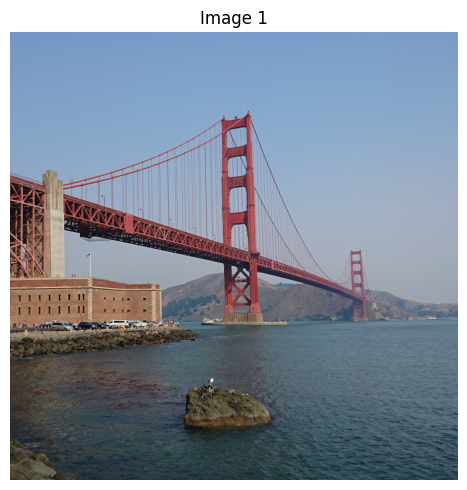
Procedura për përdorimin e modelit të të menduarit me të dhëna vizuale është shumë e ngjashme. Ju mund të ofroni një imazh si pjesë të vargut të messages . Thjesht sigurohuni që ta kaloni imazhin te procesori së bashku me tekstin e formatuar dhe modeli do të arsyetojë rreth të dhënave vizuale përpara se të përgjigjet.
from PIL import Image
import matplotlib.pyplot as plt

prompt = "What is shown in this image?"
image_url = "https://raw.githubusercontent.com/google-gemma/cookbook/refs/heads/main/apps/sample-data/GoldenGate.png"

# download image
!wget -q {image_url} -O image.png
image = Image.open("image.png")

# Display all images
print("=== Downloaded image ===")
fig, ax = plt.subplots(1, 1, figsize=(5, 5))
ax.imshow(image)
ax.set_title("Image 1")
ax.axis("off")
plt.tight_layout()
plt.show()

message = [
    {
        "role": "user", "content": [
          {"type": "image"},
          {"type": "text", "text": prompt}
        ]
    }
]

text = processor.apply_chat_template(message, tokenize=False, add_generation_prompt=True, enable_thinking=True)
inputs = processor(text=text, images=image, return_tensors="pt").to(model.device)
input_len = inputs["input_ids"].shape[-1]

outputs = model.generate(**inputs, max_new_tokens=1024)
response = processor.decode(outputs[0][input_len:], skip_special_tokens=False)

result = processor.parse_response(response)

for key, value in result.items():
  if key == "role":
    print(f"Role: {value}")
  elif key == "thinking":
    print(f"\n=== Thoughts ===\n{value}")
  elif key == "content":
    print(f"\n=== Answer ===\n{value}")
  elif key == "tool_calls":
    print(f"\n=== Tool Calls ===\n{value}")
  else:
    print(f"\n{key}: {value}...\n")
=== Downloaded image ===
Role: assistant

=== Thoughts ===
Here's a thinking process to arrive at the suggested answer:

1.  **Analyze the Image:**
    *   **Dominant Structure:** The most prominent feature is a massive suspension bridge with tall red towers (pylons). This is immediately recognizable as the Golden Gate Bridge.
    *   **Foreground/Midground:** There is water (looks like the San Francisco Bay/Pacific Ocean). There is a breakwater/rocky shoreline in the immediate foreground. A small rock formation is visible in the water.
    *   **Background/Landmass:** Hills/mountains are visible in the distance, behind the bridge structure.
    *   **Other Elements:** There is a low-lying building/structure on the left (part of the bridge infrastructure or a related facility). The sky is clear and blue.

2.  **Identify Key Subject:** The central subject is the Golden Gate Bridge.

3.  **Determine Setting/Location (Contextualization):** Since it's the Golden Gate Bridge, the location is San Francisco, California.

4.  **Synthesize the Description (Drafting the Answer):** Start with the main subject and then add details about the setting.

    *   *Initial thought:* It's a picture of the Golden Gate Bridge over the water.
    *   *Refinement (Adding detail):* It shows the iconic red suspension bridge spanning a body of water, with land/hills in the background.

5.  **Review the Provided Text (Self-Correction/Verification):** The prompt includes some garbled text ("ołat" at the end), but the visual evidence is overwhelming. The task is simply to describe the image.

6.  **Final Output Generation:** (This leads to the structured, informative response.) (The final response should clearly identify the landmark.)

=== Answer ===
The image shows the **Golden Gate Bridge** in San Francisco, California.

Key elements visible in the picture are:

* **The Golden Gate Bridge:** The iconic red suspension bridge dominates the frame, spanning a large body of water.
* **Water:** The foreground features dark blue water, likely the Pacific Ocean or the San Francisco Bay.
* **Landmass/Hills:** Hills and mountains are visible in the background behind the bridge.
* **Foreground Detail:** There is a rocky shoreline and a small rock formation in the water in the immediate foreground.

In summary, it is a scenic view of the famous Golden Gate Bridge.
Përmbledhje dhe hapat e mëtejshëm
Në këtë udhëzues, mësuat se si të përdorni aftësitë e të menduarit të modeleve Gemma 4 për të gjeneruar procese arsyetimi para përgjigjeve përfundimtare. Ju trajtuat:
- Aktivizimi i modalitetit të të menduarit duke përdorur
enable_thinking=Truenëapply_chat_template. - Duke përdorur
TextStreamerpër të vëzhguar procesin e të menduarit në kohë reale. - Duke analizuar rezultatin e kombinuar në blloqe të veçanta
thinkingdheanswerduke përdorurparse_response. - Zbatimi i aftësive të të menduarit në detyrat multimodale (imazh + tekst).
Hapat e ardhshëm
Eksploro më shumë aftësi të Gemma 4: